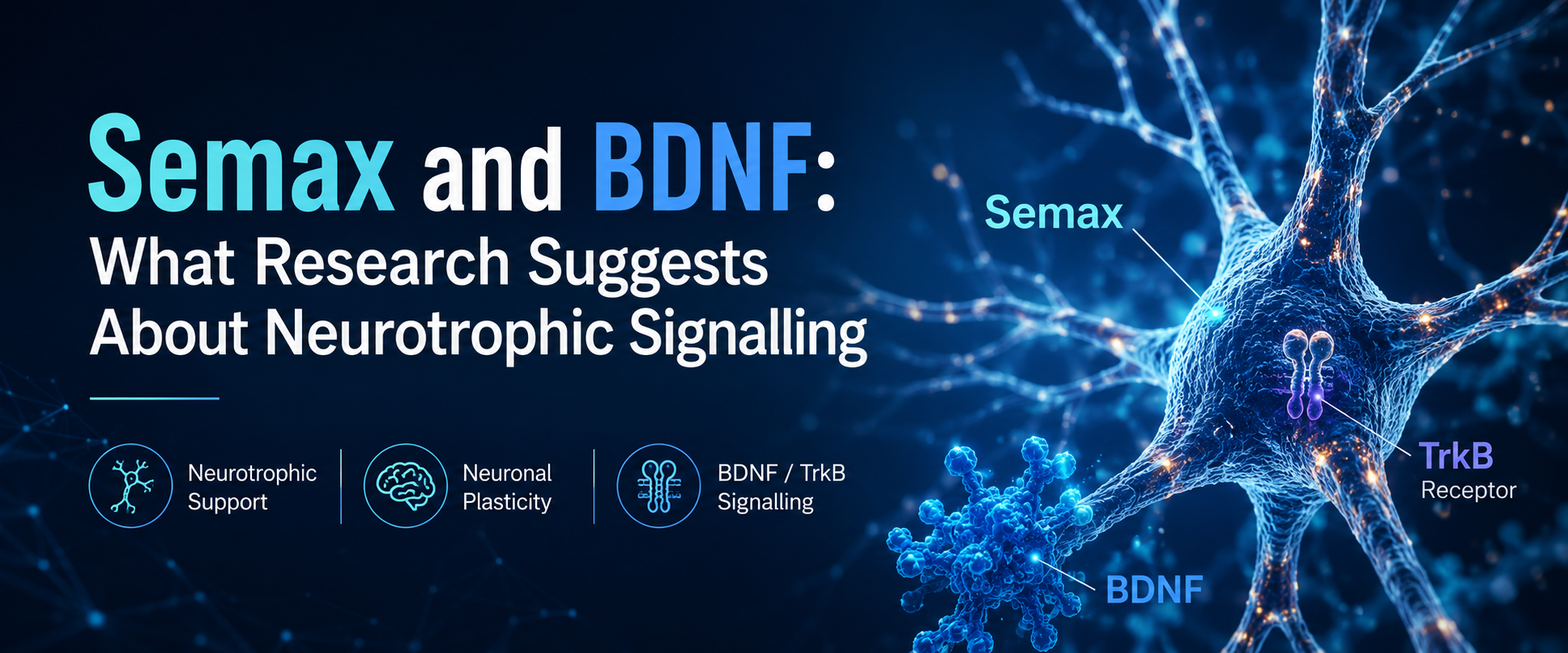
Research into Semax has moved well beyond its original link with fragments of the hormone adrenocorticotropic hormone (ACTH). One particular focus has been the possible connection between Semax and brain-derived neurotrophic factor (BDNF).
BDNF is an important signalling protein in the nervous system. It is involved in neuronal development, the modifiability of synapses and the maintenance of neuronal function. Because changes in BDNF signalling are relevant to many areas of neuroscience, researchers have examined whether experimental exposure to Semax affects this pathway.
Rodent studies have reported changes in BDNF gene expression and protein levels following Semax exposure. Researchers have also investigated TrkB, one of the main receptors through which BDNF produces its biological effects.
These observations provide an interesting mechanistic basis for Semax research, but they need to be interpreted carefully. Most of the evidence directly linking Semax and BDNF comes from experimental animal studies, and a change in a molecular signalling pathway does not necessarily imply improved cognition or neurological function in humans.
That distinction is essential when reading the research on Semax, BDNF and neurotrophic signalling.
What Is Semax?
Semax is a synthetic peptide composed of seven amino acids:
Met-Glu-His-Phe-Pro-Gly-Pro
It was developed in relation to ACTH(4–10), a fragment of the 39-amino-acid peptide hormone ACTH.
The N-terminal part of Semax is identical to ACTH(4–7), with a Pro-Gly-Pro sequence added at the C-terminal end. This structural difference is what separates Semax from ACTH and forms the basis for studying the peptide independently.
Unlike research conducted mainly on the classical adrenal activity produced by ACTH, Semax peptide research has focused on neurological processes such as learning, memory, neuronal stress responses and neurotrophic signalling.
Of these research directions, BDNF has been discussed more than most as a potential mechanism.
What Is BDNF?
BDNF belongs to the neurotrophin family.
Neurotrophins are protein signalling molecules that are essential for the development, maintenance and function of neurons. Members of the family include:
- brain-derived neurotrophic factor (BDNF);
- nerve growth factor (NGF);
- neurotrophin-3 (NT-3);
- neurotrophin-4 (NT-4).
BDNF is found throughout the nervous system, and it is particularly relevant to research on the hippocampus, cortex and other brain regions involved in neuronal plasticity.
Its role is far more complex than simply “supporting brain cells”.
BDNF participates in signalling pathways associated with neuronal patterning, synapse organisation, survival pathways and synaptic strength.
For that reason, BDNF has become an experimental marker of interest in the field of neuroplasticity.
What Is the Relationship Between Semax and BDNF?
The relationship between Semax and BDNF is drawn mainly from experimental research into whether Semax can alter BDNF gene expression or BDNF protein levels in the nervous system.
Several rodent studies have reported such changes.
In 2006, researchers examined the effects of Semax on the BDNF/TrkB system in the rat hippocampus in a study published in Brain Research.
The hippocampus is a brain region well characterised for its role in learning, memory formation and spatial information processing.
The researchers found that administering Semax produced changes in BDNF protein levels and BDNF gene expression. Changes relating to TrkB were also observed.
The significance of the finding was that it implied some of the experimental effects of Semax may involve modulation of an established neurotrophic signalling system.
It did not, however, prove that Semax produces the same effect in humans.
Why Does BDNF Matter in Neuroscience?
BDNF is involved in a wide range of biological processes, which is why it has become one of the most extensively investigated neurotrophic factors.
Neurons constantly respond to signals from neighbouring cells and from their environment. Those signals can change cell activity, protein production and even the connections between neurons.
BDNF helps carry that communication.
In particular, it is linked to synaptic plasticity — the process by which connections between neurons change in strength or structure.
Learning and memory depend on many signalling systems, but synaptic plasticity is central to them.
So when researchers observe BDNF changes after Semax exposure, it becomes reasonable to test whether other molecular or behavioural effects follow.
The key point is that BDNF sits within a network.
The up- or down-regulation of a single biomarker cannot tell the whole story about nervous-system function.
Semax and the Hippocampus
The hippocampus has been of particular interest in BDNF research on Semax.
It is one of the brain regions used most often in experimental studies of memory, learning and neuroplasticity, and it shows substantial BDNF signalling activity.
In the 2006 Brain Research study, the researchers examined BDNF and TrkB changes in the rat hippocampus.
They reported that Semax exposure led to a rise in BDNF protein concentrations, alongside changes in BDNF and TrkB gene expression at various time points in the experiment.
These details matter scientifically.
A cell’s response to a signalling molecule is not static. Gene expression can follow a different course from protein concentration, changing more quickly and later returning towards baseline.
So the question is not simply whether Semax increases BDNF.
Researchers also need to ask:
- Where does the change occur?
- When does it occur?
- How large is the response?
- How long does it persist?
- Does the molecular response correspond with a measurable functional change?
These questions show why reducing Semax research to a single biomarker can be misleading.
Semax and TrkB Signalling
BDNF does not act alone. Much of its biological activity is receptor dependent.
The receptor that plays the crucial role is tropomyosin receptor kinase B, or TrkB.
When BDNF binds to TrkB, activation of the receptor can trigger a number of intracellular signalling pathways.
Those pathways may influence cell survival, protein synthesis, synaptic function and other neuronal processes.
This is why reported effects of Semax on both BDNF and TrkB are of particular interest.
A change in BDNF concentration is one piece of evidence. Changes within the receptor system add further information about how the pathway might be regulated.
Even so, this remains mechanistic evidence.
Changes in BDNF/TrkB signalling are not the same as a therapeutic effect.
Evidence From the Rat Basal Forebrain
Another 2006 study investigated Semax in the rat basal forebrain.
Researchers reported specific binding characteristics for Semax and found increased BDNF protein levels following experimental exposure.
The basal forebrain contains neuronal systems involved in attention, arousal and cognitive processes, making it another relevant area for investigating potentially neuroactive compounds.
Together with the hippocampal findings, this research supported the hypothesis that neurotrophic signalling may be involved in some of the biological effects observed with Semax.
However, findings from two brain regions should not be generalised to the entire nervous system.
Different neural tissues can respond differently to the same signalling molecule.
Semax, BDNF and Neuroplasticity
The term neuroplasticity appears frequently in discussions of Semax.
At its simplest, neuroplasticity is the capacity of the nervous system to change in response to internal and external conditions.
Those changes can occur at several levels.
Synapses can strengthen or weaken. Neurons can alter their patterns of gene expression. Dendritic structures can change. A network of neurons can modify how it processes information.
The scientific rationale for studying Semax, BDNF and neuroplasticity together is that BDNF participates in many processes related to neuronal plasticity.
The relationship should not be overstated, however.
BDNF is not a switch that turns neuroplasticity on or off.
Neuronal adaptation involves neurotransmitters, neurotrophins, receptors, intracellular enzymes, transcription factors, structural proteins and much more.
Changes in BDNF are only one component of a far more complex biological picture.
Does Semax Increase BDNF?
This question appears frequently in discussions of Semax.
A scientifically accurate answer requires context.
Certain animal experiments have reported increases in BDNF protein or changes in BDNF gene expression following Semax exposure.
That supports the statement that Semax influenced BDNF-related measures under specific experimental conditions.
It does not justify the blanket claim that Semax simply “increases BDNF”.
The outcome may depend on factors such as brain region, species, experimental conditions and the time elapsed after exposure.
Gene expression and protein concentration are also different measurements.
An increase in transcription does not necessarily produce a proportional increase in functional protein, and increased protein does not automatically establish a particular physiological outcome.
Semax and NGF Research
BDNF is not the only neurotrophin investigated in relation to Semax.
Researchers have also studied nerve growth factor (NGF).
NGF was the first neurotrophin to be discovered and plays important roles in the development and maintenance of particular neuronal populations.
Experimental research in rats has examined changes in both Bdnf and Ngf gene expression after Semax exposure.
Researchers observed temporal and regional differences in the transcriptional response.
This is important because it suggests that Semax may not act through a single isolated pathway.
Instead, experimental exposure may influence a broader network of genes involved in neurotrophic signalling.
Understanding those networks is substantially more difficult than measuring one biomarker.
Semax in Experimental Cerebral Ischaemia
Neurotrophin pathways have also been examined in models of cerebral ischaemia.
Cerebral ischaemia is a restriction of blood flow to brain tissue that deprives brain cells of oxygen and metabolic substrates.
Laboratory models of ischaemia are used to study how nervous tissue responds to severe cellular stress.
In one rat model study, the authors compared the transcription of neurotrophins and their receptors after experimental cerebral ischaemia and exposure to Semax or Pro-Gly-Pro.
Changes were reported in genes related to BDNF, NGF and Trk receptors.
The results suggest that Semax can influence neurotrophic signalling under experimentally induced pathological stress as well as under other laboratory conditions.
This information is not a substitute for assessment by a physician and should not be used in relation to diagnosing stroke.
Animal models are research instruments. Showing molecular changes in an experimental ischaemia model is a very different matter from demonstrating efficacy in human patients.
Why Animal Research Cannot Be Directly Applied to Humans
Animal models are essential to biomedical research, but they have important limitations.
Rodents and humans share many biological pathways, including BDNF signalling. That makes rodent models valuable for investigating potential mechanisms.
Yet similarities do not mean biological responses are identical.
Differences can occur in metabolism, brain organisation, receptor expression, pharmacokinetics and disease biology.
The experimental environment also differs considerably from real-world human conditions.
Many compounds have produced promising neurological findings in animals without subsequently demonstrating meaningful clinical benefits in humans.
Semax BDNF research in rats should therefore be described as preclinical evidence, not proof of a human therapeutic effect.
What Does Human Semax Research Show?
The human evidence surrounding Semax is far more limited than the preclinical literature.
One notable study used resting-state functional magnetic resonance imaging (fMRI) to investigate brain-network activity following Semax exposure.
The study involved 24 healthy participants divided into Semax and placebo groups.
Researchers examined the brain’s default mode network and reported changes involving a medial frontal component.
This suggests that measurable alterations in functional brain-network activity occurred under the conditions of that small experiment.
However, the study does not establish that Semax increases BDNF in humans.
Nor does it prove improved memory, concentration, intelligence or general cognitive performance.
These distinctions are essential when discussing Semax cognitive research.
Molecular Changes Are Not Clinical Outcomes
One of the easiest mistakes to make when interpreting peptide research is to move too quickly from molecular findings to practical claims.
Consider the following chain:
Semax exposure → altered BDNF-related signalling → potential neuronal effects → possible functional changes
Evidence supporting the first two stages does not automatically prove the later stages.
Each step requires separate investigation.
Even when researchers observe both a molecular change and a behavioural change in animals, demonstrating causation can be difficult. Other pathways may be involved simultaneously.
Clinical claims require an even higher standard of evidence.
This is why scientifically responsible discussions of Semax peptide research should distinguish clearly between mechanism, experimental effect and established clinical outcome.
Could Semax Affect Other Signalling Pathways?
BDNF is unlikely to be the only pathway involved in the experimental effects reported for Semax.
Because the peptide is structurally related to ACTH(4–10), researchers have also looked at melanocortin-related signalling, monoamine systems and stress-response pathways.
Gene expression studies have reported changes across groups of genes linked to inflammation, oxidative stress and vascular function, not neurotrophins alone.
This becomes relevant when Semax is compared with other neuropeptides studied in similar contexts, as in discussions of Semax vs Selank.
Two compounds can produce overlapping experimental observations through different molecular routes.
Attributing every observation to one mechanism therefore risks oversimplifying the biology. At present, BDNF/TrkB signalling is best described as one well-documented area of investigation rather than a complete explanation.
Key Limitations of Semax BDNF Research
Several limitations should be considered when interpreting the existing evidence.
Much of the direct mechanistic evidence is preclinical. Rodent findings cannot automatically be generalised to humans.
Sample sizes are often limited. Small experimental studies are useful for generating hypotheses but provide less certainty than large replicated investigations.
The research also comes from a relatively concentrated scientific literature. Independent replication is particularly valuable when evaluating experimental compounds.
Different studies measure different endpoints. Gene expression, protein concentration, receptor activity, behaviour and brain imaging are not interchangeable.
Long-term human evidence remains limited. Large contemporary clinical datasets would be needed before broad conclusions about human neurological effects could be drawn.
These limitations are part of the scientific picture rather than caveats to be set aside because the molecular findings are interesting.
Semax Research in the UK
Interest in Semax peptide UK research forms part of a wider scientific interest in neuropeptides and neuronal signalling.
For UK researchers, however, scientific literature and regulatory status are separate questions.
Publication of international research does not establish that an experimental peptide is authorised as a medicine in the UK.
Researchers should therefore distinguish laboratory investigation from clinical use and check the current regulatory requirements that apply to their work.
Research materials should also be evaluated against appropriate laboratory standards, including identity, purity, batch documentation and analytical testing.
Semax, BDNF and Future Research
The existing research leaves several questions open.
Researchers still need to establish precisely how Semax interacts with cellular targets upstream of BDNF-related changes.
It is also important to determine whether the reported effects can be reproduced consistently across laboratories and experimental models.
Modern molecular techniques could help clarify which genes and proteins respond to Semax, and whether BDNF changes are central to its biological activity or part of a much broader signalling response.
Most importantly, stronger human evidence would be required to determine whether mechanisms observed in animals translate meaningfully to human physiology.
These unanswered questions make Semax a subject for continued research rather than a compound whose neurological effects can be regarded as settled.
Frequently Asked Questions
What is BDNF?
BDNF stands for brain-derived neurotrophic factor. It is a signalling protein belonging to the neurotrophin family and participates in neuronal development, synaptic function and neuroplasticity.
Does Semax increase BDNF?
Animal experiments have reported increased BDNF protein concentrations or altered BDNF gene expression following Semax exposure under specific conditions. This does not establish that Semax consistently increases BDNF in humans.
What is the connection between Semax and TrkB?
TrkB is an important receptor for BDNF. Rat studies have reported changes involving both BDNF and TrkB following Semax exposure, making the BDNF/TrkB pathway an area of interest in Semax research.
Is BDNF responsible for Semax’s effects?
That has not been conclusively established. BDNF/TrkB signalling is one proposed mechanism supported by preclinical findings, but Semax may affect multiple biological pathways.
Does Semax improve neuroplasticity?
Semax has been investigated in pathways associated with neuronal plasticity, particularly BDNF signalling. That is different from demonstrating that Semax improves neuroplasticity in humans.
Has Semax been studied in humans?
Human studies exist, including a small functional MRI study examining brain-network activity. However, much of the detailed mechanistic evidence involving BDNF comes from animal research.
Is Semax the same as BDNF?
No. Semax is a synthetic seven-amino-acid peptide. BDNF is a naturally occurring neurotrophic protein. Researchers have investigated whether Semax can influence BDNF-related signalling, but the two molecules are fundamentally different.
Conclusion
The relationship between Semax and BDNF remains an interesting area of neuroscience research. Preclinical studies suggest that Semax may influence BDNF expression, TrkB signalling and other neurotrophic pathways. However, most of the evidence comes from animal studies, and these findings do not establish cognitive or neurological benefits in humans. Further research is needed to determine how these molecular effects translate across species and whether they carry broader biological significance.
This article discusses Semax as an experimental research compound. The information is provided for scientific and educational purposes only and does not constitute medical advice, dosage guidance or a recommendation for human use.