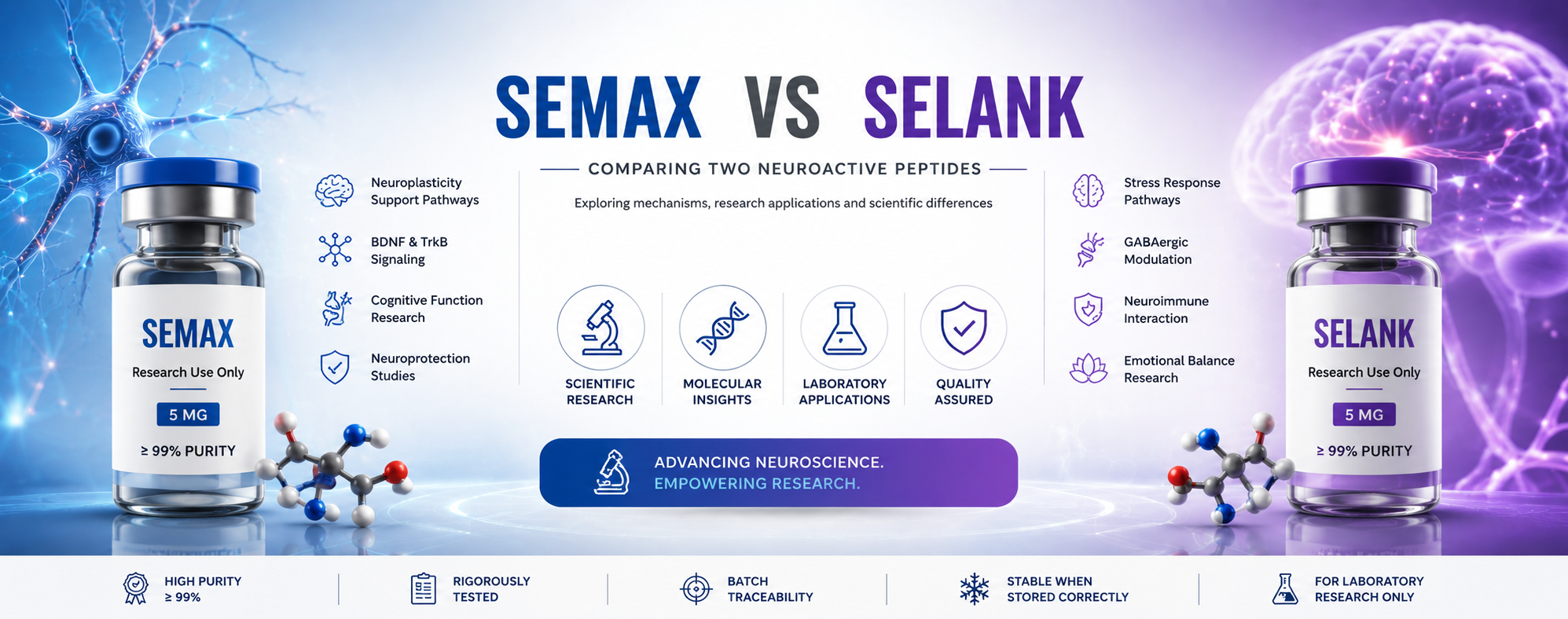
Despite the growing number of discoveries in neuroscience and the development of numerous neuroactive agents, many questions remain about the role of neuroactive peptides in regulating complex neural signalling pathways. Two examples that have gained popularity in laboratory research are Semax and Selank. Although both names appear frequently in laboratory studies, several differences separate them from a molecular, biological, and research perspective.
This article offers a brief introduction to Semax and Selank in the context of laboratory studies. It is purely informative in nature and is not intended for medical purposes or therapy recommendations. Products offered by PeptidesX UK are supplied for Research Use Only.
What Is Semax?
Semax is a synthetic peptide produced through modifications of a fragment of adrenocorticotropic hormone (ACTH 4–10). The molecule was engineered to improve stability without reducing biological activity in laboratory models of the nervous system.
Unlike the complete form of ACTH, Semax has been studied mainly in terms of neurotrophic signalling rather than endocrine effects.
To date, laboratory research has focused on its effect on:
- Neuroplasticity systems
- Neurotransmitter activity
- Synaptic signalling
- Stress responses in neurons
- Experimental models of cognition
Some papers have reported changes in brain-derived neurotrophic factor (BDNF) following treatment with Semax in experimental models.
What Is Selank?
Selank is a synthetic analogue of a naturally produced immunomodulator known as tuftsin. In developing its chemical composition, researchers altered the original structure to make it more stable while retaining biological activity.
In contrast to Semax, Selank has primarily been studied for its impact on neurotransmitter signalling involved in emotion and stress reactions, specifically:
- GABAergic signalling
- Neuroimmune communication
- Stress-related signalling pathways
- Models of behavioural neuroscience
- Cognitive processes during stress
Rather than activating neurotrophic signalling, Selank is primarily examined for its effect on inhibitory neurotransmission.
Molecular Differences
Although both peptides contain seven amino acids and share a stabilising Pro-Gly-Pro sequence, their origins differ considerably.
| Feature | Semax | Selank |
|---|---|---|
| Parent molecule | ACTH fragment | Tuftsin analogue |
| Primary research focus | Neuroplasticity | Stress regulation |
| Common laboratory models | Cognitive neuroscience | Behavioural neuroscience |
| Investigated pathways | BDNF, dopamine, serotonin | GABA, immune signalling |
| Development origin | Russian peptide research | Russian peptide research |
Despite superficial similarities, these peptides should not be considered interchangeable experimental compounds.
Mechanisms Investigated in Research
Semax
Published studies have attempted to determine whether Semax may influence several molecular pathways related to neuronal adaptation, including:
- Expression of BDNF
- TrkB signalling
- Dopamine and serotonin regulation
- Synaptic plasticity
- Oxidative stress response
- Neural gene expression
Various experiments seek to understand how these pathways affect neuronal resilience.
Selank
Current studies on Selank are usually dedicated to the investigation of various biological systems, including:
- GABA receptors
- Enkephalin metabolism
- Neuroimmune signalling
- Stress response
- Cytokine regulation
- Models of emotional behaviour
These mechanisms are still being studied in cell and animal models.
Areas of Scientific Investigation
Semax Research
- Mechanisms of learning and memory
- Signals associated with attention
- Neuroprotection experiments
- Synaptic plasticity
- Models of brain injury
- Experiments on neurodegenerative disease models
The majority of data collected to date is experimental in nature.
Selank Research
- Behavioural models of anxiety
- The physiology of stress
- Neuroimmune interactions
- Mechanisms of emotional regulation
- Learning under stress
- Neurochemical balance
Laboratory Applications
Semax and Selank can be studied through different experimental systems, including:
- Experiments conducted on cells in culture
- Molecular biology experiments
- Behavioural neuroscience studies
- Protein expression studies
- Gene expression studies
- Studies of neurotransmitter pathways
- Biomarker discovery
These laboratory experiments are preliminary and should not be taken as an indication of therapeutic application.
Structural Stability
Both peptides offer improved stability against enzymatic cleavage compared with their parent compounds. Parameters researchers consider include:
- Peptide stability
- Purity profile
- Identity confirmation
- Batch-to-batch consistency
- Storage stability
- Reproducibility of analysis
Independent analytical methods such as HPLC and LC-MS have been used to confirm the identity and purity of the peptides.
Scientific Evidence
Both Semax and Selank have been widely published, particularly in Russian scientific literature. Nevertheless, a great deal of the evidence comes from preclinical studies, while there are fewer clinical investigations on an international scale.
Present-day scientific interest remains centred on:
- Molecular signalling
- Neurochemical regulation
- Biomarkers
- Mechanistic pathways
- Experimental neurobiology
As with any peptide under study, further research is needed to clarify the biological effects of these peptides across different experimental settings.
Semax vs Selank: Key Differences
| Characteristic | Semax | Selank |
|---|---|---|
| Molecular origin | ACTH analogue | Tuftsin analogue |
| Principal research direction | Neuroplasticity | Stress biology |
| Frequently studied pathways | BDNF, TrkB, dopamine | GABA, neuroimmune signalling |
| Laboratory emphasis | Cognitive neuroscience | Behavioural neuroscience |
| Research focus | Neuronal adaptation | Neurochemical regulation |
Analytical Testing
Research-grade peptides should undergo stringent analytical validation before use in laboratory experiments. Commonly employed techniques include:
- High Performance Liquid Chromatography (HPLC)
- Liquid Chromatography–Mass Spectrometry (LC-MS)
- Peptide identification
- Purity checking
- Batch tracing
Storage Considerations
Peptide purity can be affected by storage procedures. Suggested practices for research purposes:
- Store in accordance with manufacturer instructions.
- Prevent exposure to excessive moisture and light.
- Avoid repeated freeze-thaw cycles wherever possible.
- Maintain proper documentation for traceability.
- Check analytical information prior to conducting experiments.
Conclusion
Semax and Selank fall into different classes of research peptide despite similarities in sequence length and development history. Semax is commonly researched in relation to neuroplasticity and signalling pathways, whereas Selank is often researched with respect to stress biology, inhibitory neurotransmission, and neuroimmunology.
Rather than treating the compounds as alternatives, researchers normally study them separately as tools for investigating different mechanisms. Further laboratory studies will shed more light on their molecular properties and possible applications.
Research Use Only
Both Semax and Selank from PeptidesX UK are intended solely for scientific research work. These substances are not medicines and hold no clinical approvals for human or animal use.