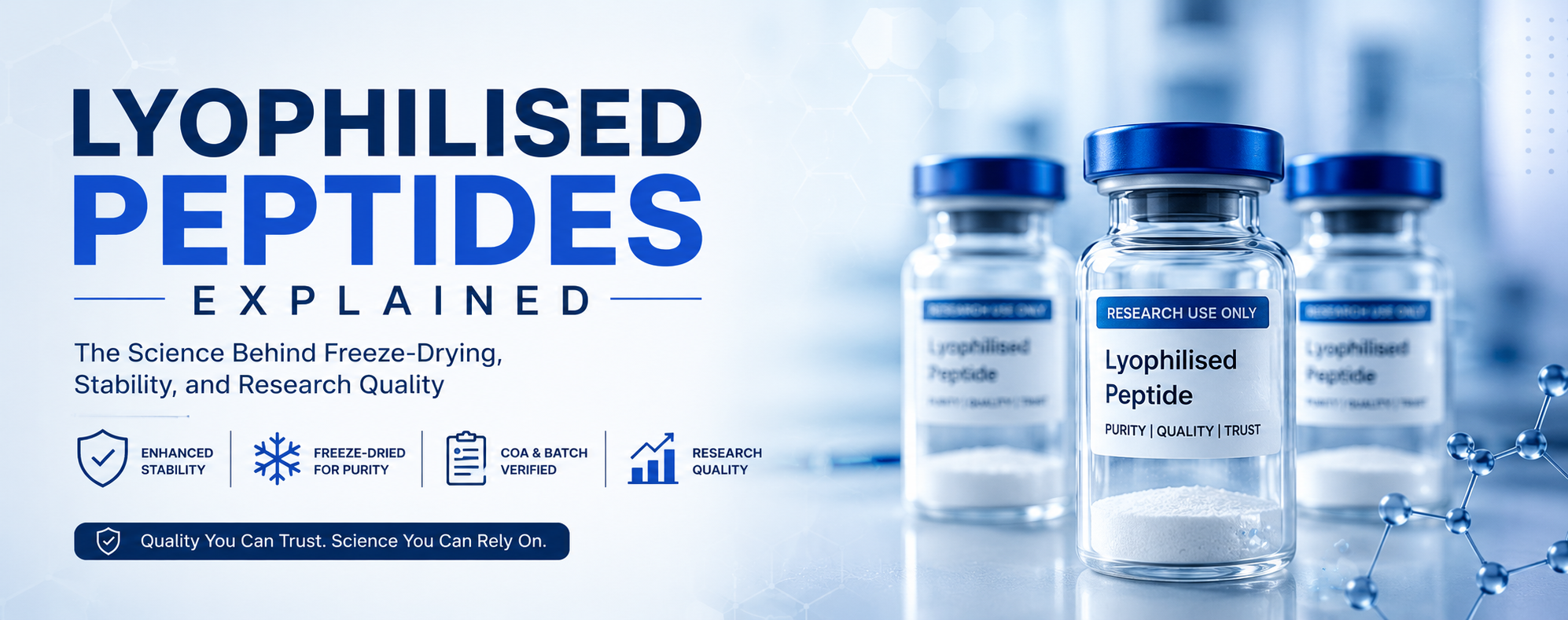
Anyone who has bought research peptides before knows that there’s usually a lot of confusion as soon as one opens up their vial and sees a small white “cake” on the bottom of the vial. However, this happens more frequently than you think and is very normal.
This is because most good research peptides are available in a lyophilised state, which means that they have been frozen-dried. Freeze-drying offers better shelf-life stability than liquid preparations. In fact, it has become the standard practice in lab production of peptides.
Having a general idea about the concept of lyophilisation peptides and its connection to COAs, HPLC testing, LC-MS validation and all the rest will help the researcher to make a correct purchase decision.
What Does “Lyophilised” Mean?
Lyophilization, also called freeze-drying, is a production technique in which water is removed from a frozen solution of peptides without heating the compound to an unacceptable temperature.
In contrast to letting ice melt into water, lyophilization eliminates the frozen water in its solid state in the form of vapor via sublimation under vacuum pressure.
This leads to a dried peptide in the form of:
- White powder
- Small solid cake
- Porous thin disc
- Porous thin layer adhered to the vial
All of these forms are perfectly normal depending on peptide chemistry and production conditions.
Why Are Research Peptides Freeze-Dried?
The peptides are sensitive polymers made up of amino acids.
In aqueous solution, they are even more vulnerable to degradation.
Methods of peptide degradation are:
- Hydrolysis
- Oxidation
- Deamidation
- Absorption of moisture
- Microbial contamination
Lyophilization removes almost all of the water in the product; hence the stability of the product is improved greatly.
The Lyophilisation Process
Although highly technical, the process generally consists of three stages.
- Freezing
The purified peptide solution is rapidly frozen.
This locks water into solid ice while maintaining the peptide’s molecular structure.
- Primary Drying
A high vacuum is applied.
Rather than melting, the ice converts directly into vapour through sublimation.
Most of the water is removed during this phase.
- Secondary Drying
Any remaining bound moisture is removed at carefully controlled temperatures.
The finished peptide is then sealed inside sterile glass vials, often under an inert atmosphere, helping preserve quality until use.
Why Researchers Prefer Lyophilised Peptides
Improved Stability
Dry peptides generally remain significantly more stable than peptides stored in solution.
Longer Shelf Life
Properly stored lyophilised peptides may remain stable for extended periods compared with aqueous solutions.
Easier Transportation
Because no liquid is present, freeze-dried peptides tolerate transportation far better than pre-mixed solutions.
Better Batch Consistency
Each production batch can undergo extensive analytical testing before release.
Reduced Risk of Degradation
Removing moisture reduces several chemical pathways that may otherwise decrease peptide purity.
Why Does My Vial Look Empty?
One of the most frequently asked questions among researchers is:
“Where is the peptide?”
Peptide at a concentration of 5 mg or even 10 mg consumes a very small amount of space.
Powder can be presented as:
- Tiny white spot
- Thin layer
- Small disk
- Barely visible fine powder in the vial
It does not mean that there is lack of substance.
Peptide concentration means mass, not volume.
Does the Appearance Affect Quality?
Not always.
Different peptides form different structures when lyophilized.
These include:
- Amino acid structure
- Molecular weight
- Concentration of salt
- Buffers
- Freeze drying process
- Residual moisture
While some peptides form hard cakes, others form fluffy structures or may not be visible at all.
Quality cannot be judged merely on the basis of appearance.
Rather, objective documentation of quality is recommended for researchers.
Why a Certificate of Analysis (COA) Matters
The Certificate of Analysis (COA) is among the most crucial quality assurance documents which are supplied along with research peptides.
Instead of depending on mere claims made in marketing of these peptides, scientists can examine the analysis results available for each batch manufactured.
A good COA usually contains information about:
- Batch/Lot Number
- Product Name
- Purity %
- HPLC Profile
- LCMS/Mass Spectrometry Data
- Molecular Weight Verification
- Date of Manufacturing
- Date of Testing
- Analyst’s Signature
- Storage Instructions
Lot specific COAs increase transparency for scientists to confirm if the product they received is as per lab standards.
Understanding HPLC Testing
High Performance Liquid Chromatography (HPLC) is one of the most widely used analytical techniques for peptide purity assessment.
HPLC separates peptide components and helps identify:
- Main peptide peak
- Impurities
- Degradation products
- Relative purity
Many reputable suppliers publish HPLC chromatograms within their COAs.
While purity percentages vary depending on the peptide, researchers should always verify analytical documentation rather than relying solely on product descriptions.
Why LC-MS Testing Is Also Important
Liquid Chromatography-Mass Spectrometry (LC-MS) complements HPLC by confirming molecular identity.
Where HPLC primarily evaluates purity, LC-MS helps verify:
- Molecular weight
- Expected peptide identity
- Manufacturing accuracy
Using both analytical methods provides stronger confidence in research materials.
Batch Traceability
Professional peptide manufacturers maintain complete batch records throughout production.
Batch traceability typically includes:
- Raw material records
- Manufacturing dates
- QC testing
- Analytical reports
- Packaging records
- COA issuance
- Batch verification
Researchers can then match the vial label directly with its Certificate of Analysis.
This improves transparency and laboratory documentation.
Packaging Standards Matter Too
Quality goes beyond merely synthesizing peptides.
Correct packaging ensures stability during storage and transportation.
The professionals in labs usually use:
- Sterile borosilicate glass vials
- Crimp sealed closures
- Rubber stoppers
- Moisture-proof packaging
- Protective secondary packaging
- Batch labeled packaging
Packaging plays a significant role in the quality process.
Storage Best Practices
In order to ensure peptide stability, all researches must strictly adhere to manufacturer guidelines for storing peptides.
Some general guidelines for proper storage are as follows:
- Ensure that any unopened lyophilized peptides are stored as per manufacturer’s directions.
- Prevent excessive exposure to moisture.
- Avoid exposing the peptide to excessive heat.
- Do not expose to direct sunlight.
- Prevent frequent changes in temperatures.
- Adhere to the storage instructions provided by the Certificate of Analysis or the product label.
Common Misconceptions About Lyophilised Peptides
Myth 1: Bigger Powder Means Higher Quality
False.
Peptide volume varies significantly depending on molecular structure.
Myth 2: The Vial Looks Empty
False.
Even several milligrams occupy very little space.
Myth 3: Powder Shape Determines Purity
False.
Only analytical testing can determine purity.
Myth 4: Every White Powder Is Identical
False.
Identity should always be confirmed through LC-MS and documented in the Certificate of Analysis.
Choosing a Reliable Research Peptide Supplier
When considering the suppliers, do not concentrate only on the prices.
Suppliers that care about quality will offer:
- Specific batch Certificates of Analysis
- HPLC purity testing
- LC-MS testing
- Batch tracking
- Transparency of the testing procedure
- Temperature requirements
- Quality assurance documents
- Labelling consistency
- Package quality
- Techincal support
This is how you can see their dedication to research quality.
Frequently Asked Questions
What are lyophilised peptides?
Freeze-dried peptides can be described as peptides that have been subjected to lyophilisation to get rid of water in their composition without affecting stability.
Why aren’t peptides supplied as liquids?
No. Dry peptides will offer more stability and less degradation than aqueous solutions.
Does a small amount of powder mean less peptide?
No. Peptides take up little volume, so you could fill all your vials up with very little visible substance.
Is a Certificate of Analysis important?
Yes. Batching COA ensures that researchers will be able to analyse the results of analytical testing prior to using any research material.
Should I verify HPLC results?
Yes. Reviewing HPLC and LC-MS analysis data will help confirm the validity of the research materials that are provided.
Conclusion
Lyophilization is not just a means of packing but a crucial preservative technique which helps in maintaining peptide stability, minimizing degradation, and conducting reliable scientific research. Though the look of a lyophilized peptide may differ from one to another, quality of a product should always be judged based on analytical facts, not merely by sight.
Researchers should consider working with suppliers who offer Certificate of Analysis (COA) for every batch of products, HPLC purification, and LC-MS identification tests.