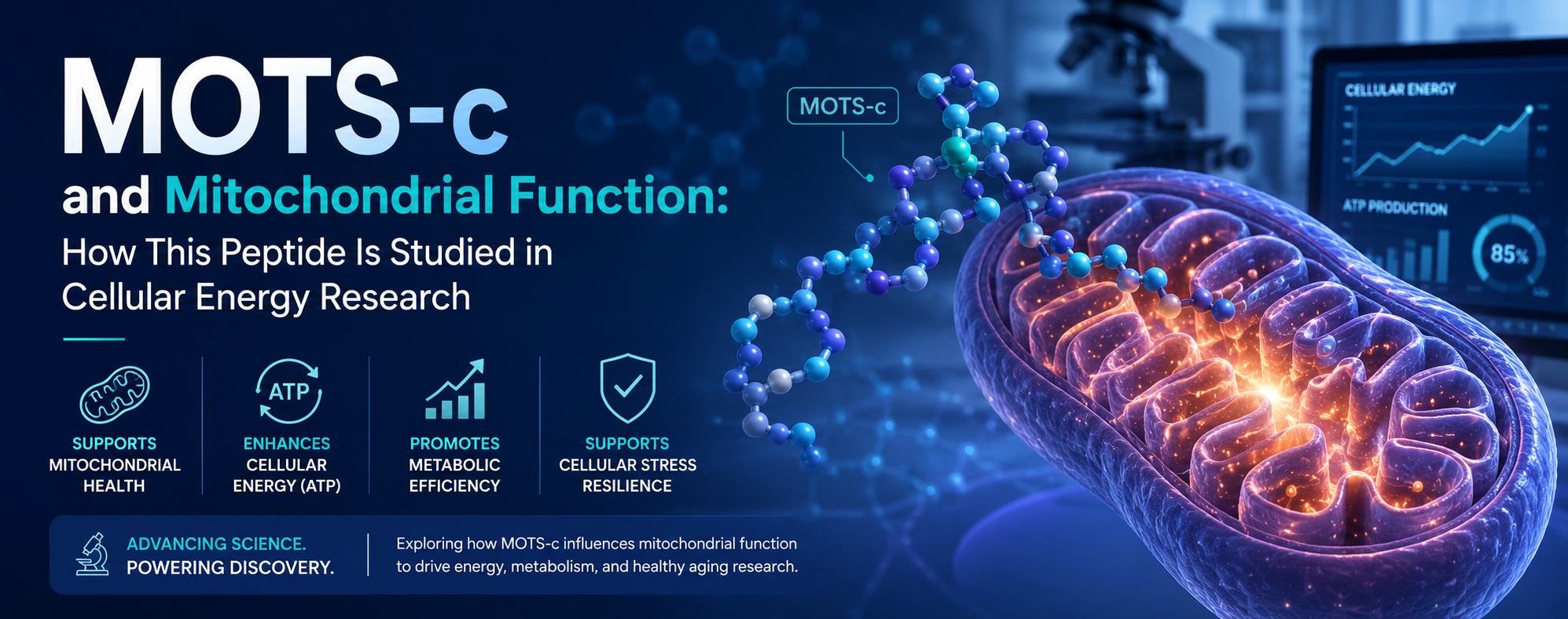
Most of us met mitochondria in a biology lesson as the part of the cell that makes energy. That description holds up, but it has aged badly as a summary. Over the past two decades mitochondria have turned out to be involved in metabolic sensing, oxidative stress responses, conversations with the nucleus, and the sort of ongoing adjustment that lets a cell cope with changing conditions.
Out of that shift came a fairly recent line of enquiry into mitochondrial-derived peptides, or MDPs. These are small peptides encoded by short open reading frames inside mitochondrial DNA. The one that has attracted the most attention is MOTS-c, a 16-amino-acid peptide first described in 2015.
Its origin is what makes it unusual. The sequence sits inside the mitochondrial 12S ribosomal RNA region, and since 2015 researchers have connected MOTS-c to cellular metabolism, mitochondrial-to-nuclear communication, and metabolic stress responses. Newer experimental work has gone a step further and asked whether the peptide affects mitochondrial bioenergetics directly.
All of which makes MOTS-c a compound worth reading about. It does not make it a proven treatment. Almost all of the mechanistic evidence comes from cells and animals, and the basic questions about how it behaves in humans have not been answered yet.
What Is MOTS-c?
The name stands for mitochondrial open reading frame of the 12S rRNA type-c. It sits in the same family as humanin and the small humanin-like peptides (SHLPs), all of which are grouped together as mitochondrial-derived peptides.
MOTS-c is 16 amino acids long, and it is encoded within the MT-RNR1 region of mitochondrial DNA.
That last detail matters more than it might sound. Nearly all of the proteins that run mitochondrial function are encoded by nuclear DNA, built in the cytosol, and then imported into the mitochondria. What MDP research points to is a mitochondrial genome that may also contribute something of its own to cellular signalling, rather than acting purely as a set of instructions for local machinery. MOTS-c is the working model for testing that idea.
Mitochondria Do Rather More Than Make ATP
Mitochondria contribute to a long list of processes:
- ATP production
- nutrient oxidation
- redox regulation
- calcium signalling
- generation of reactive oxygen species (ROS)
- apoptosis
- cellular stress responses
- metabolic adaptation
All of these are adjusted continuously depending on how much fuel is available and how much energy the cell needs. During fasting, exercise, nutrient excess and other metabolic stresses, mitochondria cannot simply get on with it in isolation. Information about their status has to reach the rest of the cell, and some of that traffic runs backwards from the mitochondria to the nucleus. Researchers call this retrograde signalling, and it is the process MOTS-c has been proposed to take part in.
Mitochondrial-to-Nuclear Communication
One of the more striking findings in this field is that MOTS-c can move into the nucleus under certain conditions.
Experimental work suggests metabolic stress is what prompts that translocation, and once MOTS-c is in the nucleus it has been linked to changes in the expression of genes involved in stress adaptation. Nuclear MOTS-c activity has also been associated with transcription factors in stress-response pathways, NRF2 among them.
The implication is worth sitting with for a moment. The nucleus controls transcription of thousands of genes, plenty of them tied to metabolism and to mitochondrial function itself. A peptide encoded in the mitochondrion that can influence nuclear gene expression would give mitochondrial status a direct route into wider cell behaviour. That is why MOTS-c tends to be discussed now as one part of a mitochondrial signalling network rather than as a molecule that only does things inside mitochondria.
MOTS-c for Laboratory Research
Every batch we supply ships with its own HPLC-verified Certificate of Analysis, so the material in your protocol is documented before it reaches the bench. Reconstitution volumes can be worked out in advance with our mixing calculator.
99%+ purity · Batch CoA every order · Same-day UK dispatch
For in-vitro laboratory research only. Not for human consumption or therapeutic use.
The Folate, AICAR and AMPK Route
Most of the mechanistic discussion around MOTS-c comes back to AMP-activated protein kinase, usually shortened to AMPK.
AMPK is one of the cell’s main energy sensors. When energy availability shifts, it ramps up processes that generate energy and puts the brakes on some of the ones that consume it, which makes it a central node in metabolic homeostasis.
MOTS-c has been reported to influence folate and purine metabolism in a way that can lead to accumulation of the metabolite AICAR, and AICAR is well established as an AMPK activator. That gives the commonly cited chain:
MOTS-c → folate/purine metabolism → AICAR → AMPK signalling
It is a tidy summary of a considerably less tidy set of processes, but it explains why so much MOTS-c work circles back to AMPK. Once AMPK is involved, glucose metabolism, lipid metabolism, mitochondrial regulation and the response to energetic stress are all potentially in scope.
Cellular Energy Metabolism
Early MOTS-c research leaned heavily on metabolic outcomes. In cell and animal experiments, the peptide appeared to influence glucose utilisation and pathways associated with insulin sensitivity, with reported changes in glucose uptake, glycolytic activity and metabolic flexibility when MOTS-c signalling was manipulated.
That body of work is largely responsible for the attention the peptide receives.
The caveat is the familiar one. Cell culture and rodent studies showing that a peptide alters metabolic function tell you nothing definitive about what happens in a human being. Dosage, exposure, species biology, experimental conditions and baseline metabolic state can all pull results in different directions, which is why data of this kind is described as mechanistic evidence rather than clinical proof. Anything sold for laboratory work carries the same framing for the same reason, and reputable suppliers label it as research use only rather than implying any tested application.
Does MOTS-c Act on Mitochondrial Function Directly?
Associations between MOTS-c and metabolic signalling were established fairly early. Whether the peptide does anything directly to mitochondrial bioenergetics was less obvious, and it took work in skeletal muscle models to start addressing it.
A recent study of this kind reported that MOTS-c improved certain aspects of muscle bioenergetic function in mice, and that both PGC-1α and AMPK signalling were needed for those effects to appear. The same work recorded lower mitochondrial ROS emission and fewer markers of ROS-related protein damage.
The detail worth flagging is that the improvements were not explained by increases in the abundance of mitochondrial respiratory proteins. If that holds, MOTS-c may be affecting what existing mitochondria can do rather than simply how many of them there are. The interventional findings are from animals, so the reading has to stay cautious, but it is a useful addition to the mechanistic picture.
The AMPK and PGC-1α Relationship
PGC-1α turns up in almost every discussion of mitochondrial biology. It is a transcriptional coactivator involved in mitochondrial biogenesis, oxidative metabolism and adaptation to energy demand, and it is tightly coupled to AMPK in the regulation of cellular energy.
So when experimental mitochondrial effects of MOTS-c turn out to depend on both, it hints at a link between mitochondrial-derived signalling and the pathways that coordinate energetic adaptation across the cell. How those pathways interact in detail, and whether the same relationships hold across tissues and species, has not been settled.
Oxidative Stress
Reactive oxygen species are a normal by-product of cellular metabolism, and they are not inherently harmful. At controlled concentrations they work as signalling molecules. Produced in excess, they damage proteins, lipids and DNA.
Mitochondria sit at the centre of cellular redox biology, so it was always likely that MOTS-c would be examined in this context. Experimental findings link it to NRF2-associated signalling and to other pathways involved in adaptive responses to oxidative stress, and the skeletal muscle work mentioned above reported reduced mitochondrial ROS emission after MOTS-c administration.
Findings like these are part of why MOTS-c is now described as a mitochondrial signalling peptide rather than a glucose metabolism regulator with an interesting backstory.
NAD+ and SIRT1
MOTS-c research also brushes up against NAD+ biology. NAD+ is a coenzyme required for a wide range of cellular redox reactions and a substrate for several signalling enzymes, and some experimental work connects MOTS-c to NAD+ and SIRT1-related pathways.
SIRT1 is an NAD+-dependent deacetylase involved in regulating metabolic pathways and stress responses, and it interacts with both AMPK and PGC-1α signalling.
The overlap makes a general point about this field. MOTS-c, AMPK, NAD+, SIRT1 and PGC-1α are not interchangeable, and none of them can be studied in isolation. They belong to interrelated regulatory networks that are still being mapped.
Why Skeletal Muscle Keeps Coming Up
Skeletal muscle is a high-demand tissue that responds quickly to changes in energy requirements. During exercise, muscle cells shift how they produce ATP, how much glucose they draw on, how they oxidise fatty acids and how mitochondria are recruited, all within minutes. That makes it an obvious place to look for a peptide thought to be involved in metabolic adaptation.
Researchers have examined MOTS-c expression in muscle, circulating concentrations, and the relationship between MOTS-c and exercise-associated metabolic adaptation.
One human exercise physiology study is worth mentioning because it complicates the picture. Interstitial MOTS-c concentrations rose during exercise, but no arterio-venous difference was detectable across working skeletal muscle, which makes it harder to argue that contracting muscle is the source of circulating MOTS-c. Results like that are a reminder that the basic biology is still being worked out, not tidied up.
What Is Still Unknown
Publication volume has climbed steadily, but several fundamental questions remain open. How MOTS-c is produced and regulated in different tissues, how it moves between cellular compartments, whether it has specific receptors, and how circulating levels relate to activity inside cells are all unresolved.
Then there is the translation gap, which is the more important issue for anyone reading about this online.
The eye-catching data comes from cultured cells and rodents. Human studies have mostly measured endogenous MOTS-c concentrations and looked for physiological correlations, and that is a different thing from controlled evidence about administering the peptide. Claims that skip over the distinction are common, and it is usually the fastest way to tell a serious source from a promotional one.
Where This Leaves MOTS-c
The research is doing something more interesting than adding another compound to a list. It is part of a broader change in how mitochondria are understood, from isolated ATP generators to participants in signalling networks that respond to metabolic and environmental stress. Mitochondrial-derived peptides may be one element of that system.
MOTS-c connects to AMPK signalling, nuclear gene regulation, metabolic adaptation, oxidative stress and mitochondrial bioenergetics, which is a lot of ground for a 16-amino-acid peptide to cover and a good reason for the attention it gets.
It is also a young evidence base. MOTS-c is not a proven method of improving mitochondrial function, and treating it as an experimental research compound is the only reading the data currently supports. Well-controlled human studies will decide how much of the cell and animal work carries across. More background on peptide research and testing is available across the PeptidesX knowledge hub.
MOTS-c is discussed here for scientific and educational purposes only. Research findings, particularly those from cell and animal experiments, should not be interpreted as evidence of approved therapeutic use, nor as medical advice.