
Be it for educational purposes or if you wish to enrich your knowledge, here you can learn more about peptides, their functionality, uses in research, and the necessity of high-quality testing when purchasing research materials.
What Are Peptides?
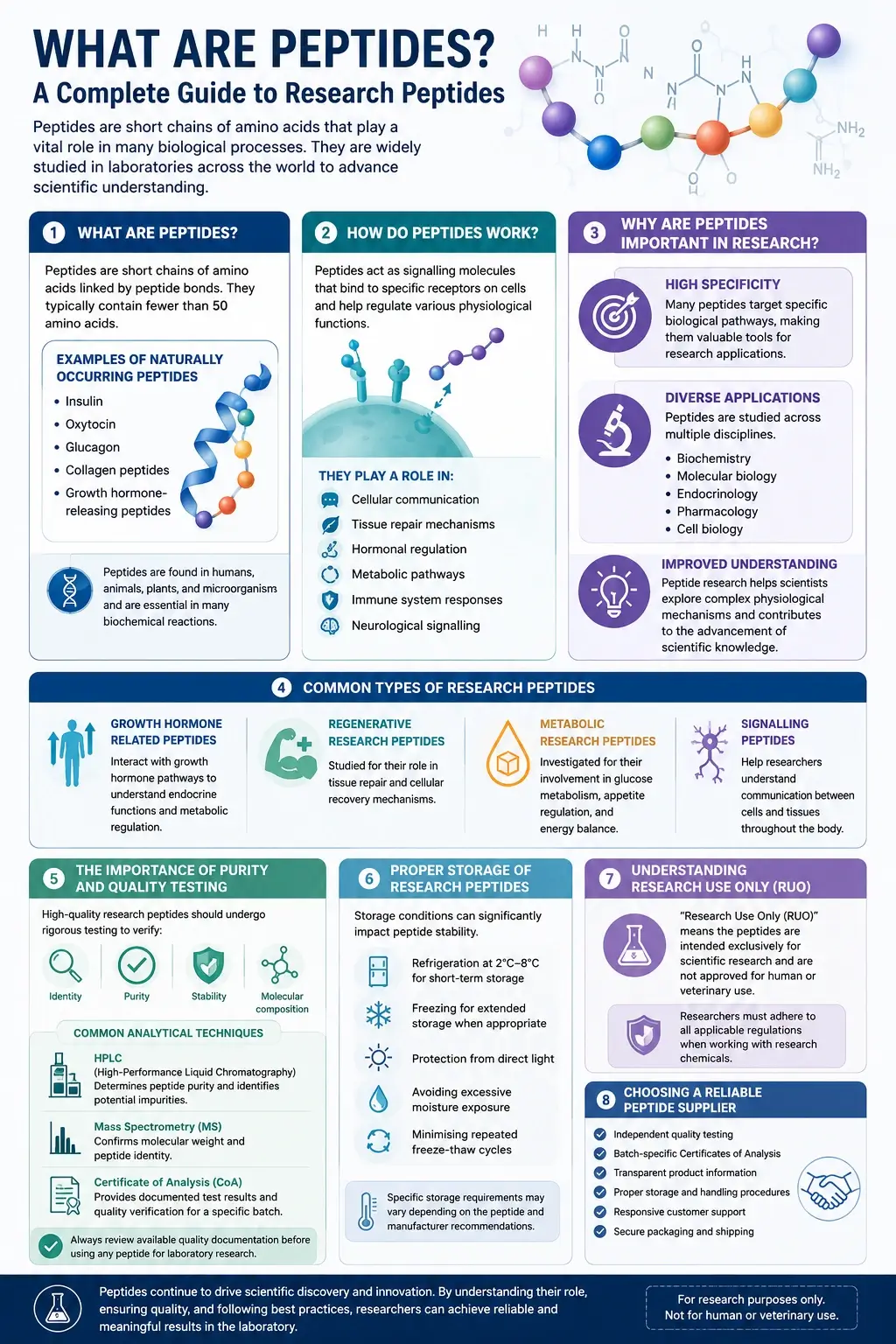
Peptides consist of a sequence of amino acids joined together by peptide bonds. Amino acids are known as the building blocks of proteins. In contrast to the large number of amino acids found in a protein, a peptide usually consists of less than 50 amino acids.
These compounds can be found in humans, animals, plants, and microorganisms. Peptides play an essential role in many biochemical reactions.
Examples of naturally occurring peptides include:
- Insulin
- Oxytocin
- Glucagon
- Collagen peptides
- Growth hormone-releasing peptides
Because of their biological significance, peptides have become an important area of scientific investigation.
How Do Peptides Work?
Peptides act as signalling molecules within biological systems. They interact with specific receptors located on cells, helping regulate various physiological functions.
Researchers study peptide interactions to better understand processes such as:
- Cellular communication
- Tissue repair mechanisms
- Hormonal regulation
- Metabolic pathways
- Immune system responses
- Neurological signalling
The specific function of a peptide depends on its amino acid sequence and structure.
Why Are Peptides Important in Research?
Peptides offer several advantages in laboratory settings:
High Specificity
Many peptides target specific biological pathways, making them valuable tools for research applications.
Diverse Applications
Scientists investigate peptides across multiple disciplines, including:
- Biochemistry
- Molecular biology
- Endocrinology
- Pharmacology
- Cell biology
Improved Understanding of Biological Processes
Peptide research helps scientists explore complex physiological mechanisms and contributes to the advancement of scientific knowledge.
Common Types of Research Peptides
Several peptide categories are commonly studied in research environments.
Growth Hormone Related Peptides
Researchers examine peptides that interact with growth hormone pathways to better understand endocrine functions and metabolic regulation.
Regenerative Research Peptides
Certain peptides are studied for their role in tissue repair and cellular recovery mechanisms.
Metabolic Research Peptides
Scientists investigate peptides involved in glucose metabolism, appetite regulation, and energy balance.
Signalling Peptides
These peptides help researchers understand communication between cells and tissues throughout the body.
The Importance of Purity and Quality Testing
When conducting research, peptide quality is essential.
High-quality research peptides should undergo rigorous testing to verify:
- Identity
- Purity
- Stability
- Molecular composition
Common analytical techniques include:
High-Performance Liquid Chromatography (HPLC)
HPLC is used to determine peptide purity and identify potential impurities.
Mass Spectrometry (MS)
Mass spectrometry helps confirm molecular weight and peptide identity.
Certificate of Analysis (CoA)
A Certificate of Analysis provides documented test results and quality verification for a specific batch.
Researchers should always review available quality documentation before using any peptide for laboratory research.
Proper Storage of Research Peptides
Storage conditions can significantly impact peptide stability.
General storage recommendations often include:
- Refrigeration at 2°C–8°C for short-term storage
- Freezing for extended storage when appropriate
- Protection from direct light
- Avoiding excessive moisture exposure
- Minimising repeated freeze-thaw cycles
Specific storage requirements may vary depending on the peptide and manufacturer recommendations.
Understanding Research Use Only (RUO)
There are also many peptides from research suppliers marked as “Research Use Only (RUO).”
The RUO label is used to show that the peptides are meant only for scientific research and are not approved for any human or veterinary applications.
It should be noted that researchers must adhere to all regulations when working with research chemicals.
Choosing a Reliable Peptide Supplier
When sourcing research peptides, consider factors such as:
- Independent quality testing
- Batch-specific Certificates of Analysis
- Transparent product information
- Proper storage and handling procedures
- Responsive customer support
- Secure packaging and shipping
A reputable supplier helps ensure consistency and reliability for research projects.
Conclusion
The utilization of peptides in scientific investigations is still significant because of their special biological characteristics and wide range of uses. The use of peptides is critical in understanding cell signaling processes, metabolic and physiological processes, and other types of investigation in scientific studies.
With the increasing need for the use of peptides in research, choosing quality peptides with proper documentation becomes very important. Knowledge about peptides can be advantageous in making good decisions regarding researches in the laboratory setting.
Products supplied by PeptidesX are intended for laboratory research purposes only. They are not intended for human consumption, medical use, diagnosis, treatment, or prevention of any disease.