Introduction
Quality verification is a critical component of peptide research. Whether a peptide is used for analytical, biochemical or laboratory testing, scientists need to be sure that what they have received fits the description provided in the documentation.
That is when third-party testing becomes essential.
Instead of trusting only to the manufacturer’s own quality assurance procedures, scientists can order an analysis by independent laboratories to make sure that the product they have received is exactly what it should be.
This article will tell you what third-party testing is, how it is done and why it is so important. It will also show you how to read the certificate of analysis.
What Is Third-Party Testing?
Third party testing is defined as the act of submitting the peptide samples to an independent laboratory, which does not have any financial stake in the manufacture and sale of the product.
The independent laboratory then conducts scientific analysis using analytical methods that are proven to be effective and gives unbiased results since it does not receive any pressure from the manufacturer.
It can be noted that third-party testing is not like the internal quality control.
Why Independent Testing Matters
Manufacturing peptides involves multiple complex processes including:
- Peptide synthesis
- Cleavage
- Purification
- Lyophilisation
- Filling
- Packaging
- Storage
Each stage has the potential to influence final product quality.
Independent testing helps verify that manufacturing has produced material consistent with the documented specifications.
Researchers often look for evidence that confirms:
- Identity
- Purity
- Batch consistency
- Analytical documentation
- Laboratory traceability
Without independent verification, researchers must rely solely on manufacturer claims.
Internal Testing vs Third-Party Testing
| Internal Testing | Third-Party Testing |
|---|---|
| Performed by manufacturer | Performed by independent laboratory |
| Used for production quality control | Used for independent verification |
| May not always be publicly available | Results often provided through COAs |
| Supports manufacturing process | Supports transparency and confidence |
Both forms of testing are valuable, but independent verification provides additional assurance.
What Does Third-Party Testing Usually Measure?
Independent laboratories commonly evaluate several characteristics.
1. Identity Verification
Identity testing confirms that the material analysed matches the peptide listed on the label.
Methods may include:
- LC-MS
- Mass spectrometry
- Molecular weight verification
This confirms the correct peptide has been synthesised.
2. Purity Analysis
Purity refers to the percentage of the sample consisting of the intended peptide.
One of the most common analytical methods is:
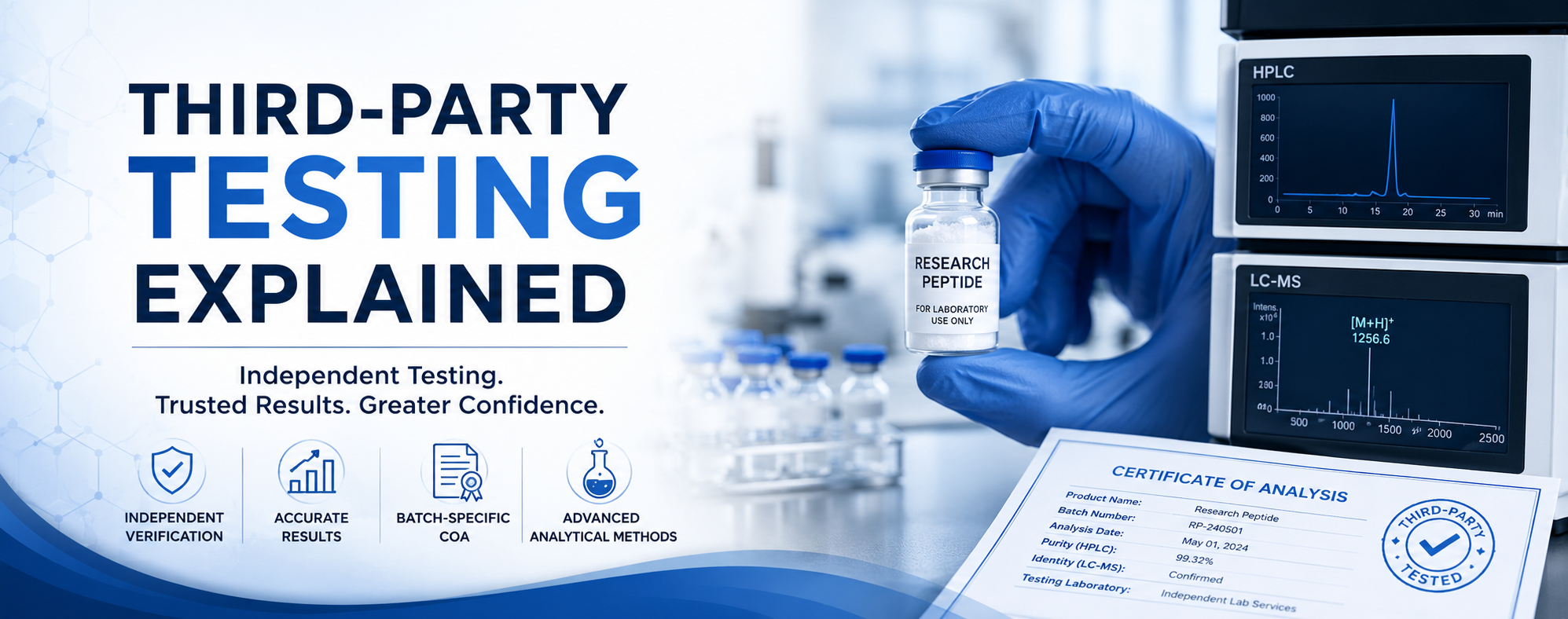
High Performance Liquid Chromatography (HPLC)
An HPLC chromatogram separates compounds within the sample and measures the proportion represented by the target peptide.
Many research suppliers provide Certificate of Analysis documentation showing reported purity obtained through HPLC testing.
3. Molecular Weight Confirmation
Mass spectrometry determines whether the measured molecular weight aligns with the expected molecular formula.
This helps verify peptide identity.
LC-MS combines:
- Liquid chromatography
- Mass spectrometry
making it one of the most informative analytical techniques available.
4. Batch Consistency
Independent laboratories may analyse multiple production batches over time.
This allows researchers to evaluate whether product quality remains consistent between manufacturing runs.
Consistent analytical results indicate stable production processes.
Common Testing Methods
High Performance Liquid Chromatography (HPLC)
HPLC is widely used to determine purity.
The technique separates compounds according to their chemical properties.
Researchers receive:
- Chromatograms
- Retention times
- Purity percentage
HPLC is considered one of the standard analytical tools used in peptide quality assessment.
Liquid Chromatography-Mass Spectrometry (LC-MS)
LC-MS combines two analytical methods.
Liquid chromatography first separates the sample.
Mass spectrometry then identifies compounds based on molecular weight.
LC-MS provides stronger confirmation of identity than chromatography alone.
Mass Spectrometry (MS)
Mass spectrometry measures molecular mass with high precision.
It confirms that the peptide corresponds to its expected molecular structure.
Amino Acid Analysis
Some laboratories perform amino acid analysis to further evaluate peptide composition.
Although less common for routine batch verification, it may be used in research environments requiring extensive characterisation.
Understanding a Certificate of Analysis (COA)
A Certificate of Analysis is a laboratory document summarising analytical findings for a specific production batch.
Researchers commonly use the Certificate of Analysis when reviewing peptide quality documentation before laboratory use.
Typical information includes:
- Product name
- Batch number
- Manufacturing date
- Analysis date
- Testing laboratory
- Identity
- Purity
- Analytical method
- Storage recommendations
Every production batch should have its own Certificate of Analysis, allowing researchers to verify the documentation corresponds to the specific product received.
Why Batch Numbers Matter
Every production run receives a unique batch number.
This allows:
- Product traceability
- Manufacturing documentation
- Laboratory testing records
- Quality investigations
- COA verification
Researchers should confirm that the batch number printed on the product matches the number shown on the Certificate of Analysis.
Transparency Builds Confidence
Suppliers demonstrating transparent quality practices often provide:
- Batch-specific COAs
- Independent laboratory reports
- Testing methodology
- Storage guidance
- Product specifications
Transparent documentation allows researchers to review analytical evidence before beginning laboratory work.
Limitations of Third-Party Testing
Although third-party testing provides valuable verification, it does have limitations.
Independent testing represents the sample submitted for analysis.
Researchers should also consider:
- Storage conditions
- Transport conditions
- Packaging integrity
- Batch traceability
- Supplier quality systems
Testing is one component of an overall quality assurance programme rather than a complete guarantee.
Questions Researchers Should Ask
Before purchasing research materials, researchers often review:
- Is a batch-specific Certificate of Analysis available?
- Was testing performed by an independent laboratory?
- Which analytical methods were used?
- Is HPLC purity reported?
- Is LC-MS identity confirmation available?
- Does the batch number match the COA?
- Are storage recommendations provided?
These questions help researchers evaluate the level of transparency offered by a supplier.
Best Practices for Researchers
During receipt of peptide substances:
- Ensure the batch number is available.
- Study the Certificate of Analysis.
- Determine the analytical techniques employed.
- Note the purity indicated.
- Adhere to storage instructions.
- Document the batch details in lab reports.
- Keep quality records with experiment records.
Documentation ensures adherence to good laboratory practice.
Conclusion
Testing by a third party gives an independent evaluation of the peptide identity, purity, and analytical quality. Through the use of known laboratory methods like HPLC, LC-MS, and mass spectrometry, independent labs can assist in ensuring that the research material meets specified standards.
For researchers, checking the Certificate of Analysis, establishing batch traceability, and knowing the method of analysis are all important aspects of evaluating the peptide quality. Although third party testing is just one aspect of the overall quality control process, it plays a crucial role in fostering transparency and consistency in research materials.