Purity is undoubtedly one of the primary factors in peptide analysis. Whatever type of study is being conducted, whether related to receptors’ action, cellular communication, repair processes, metabolism or longevity, scientists require well-characterized reagents to conduct their experiments and obtain valid and replicable data.
However, what does “99% purity” really mean? Does it indicate that 99% of the material inside the vial is the target peptide? What are the other 1% then, and how is purity assessed? Can there be two products of the same purity level but differing in quality?
By answering these questions, researchers can better assess their peptide’s quality and understand the data presented in COA documents.
This article covers what peptide purity means, how it is checked using certain analytical methods, the role of high-performance liquid chromatography and LC-MS in this process, and why batch-based analysis is crucial for consistent research results.
What Is Peptide Purity?
Peptide purity is the ratio of the required peptide versus peptide-related impurities in the sample.
While manufacturing the peptides, a lot of reactions take place. Despite being highly advanced, these methods leave certain amounts of side-products that cannot be avoided during the peptide synthesis process.
They can be:
- Uncompleted peptide chains
- Deleled amino acid chain parts
- Oxidized peptides
- Truncated peptides
- Side-products from synthesis
- Degradation products
Testing for purity gives the amount of desired peptide against peptide-related impurities.
Such as:
- Purity 95% means about 95% of peptide-related substances are the intended peptide.
- Purity 98-99% shows a very purified product suitable for most laboratory experiments.
Why Peptide Purity Matters
Research outcomes depend heavily on material quality.
Even small quantities of impurities may influence laboratory observations by introducing additional biological activity or affecting analytical measurements.
High peptide purity contributes to:
- Better experimental reproducibility
- Reduced background interference
- Greater confidence in analytical data
- Improved consistency between research batches
- Easier interpretation of laboratory findings
For studies involving sensitive analytical techniques, purity becomes increasingly important because unwanted components may affect assay performance or complicate data interpretation.
Why No Synthetic Peptide Is Truly 100% Pure
It is a misconception that peptides produced in the lab have to be absolutely pure.
On the contrary, peptides manufacture is performed through repeated coupling, deprotection and purification stages. Trace impurities cannot but appear as a part of each production cycle.
They can be formed due to:
- Uncoupling of amino acids
- Oxidation processes during peptide manufacture
- Side chain reactions
- Cleavage processes
- Degradation associated with storage.
That is why purity is determined by analytical labs.
99% of purity means very good analysis result.
How Peptide Purity Is Measured
Modern peptide manufacturers use advanced analytical chemistry techniques to evaluate product quality.
The most common methods include:
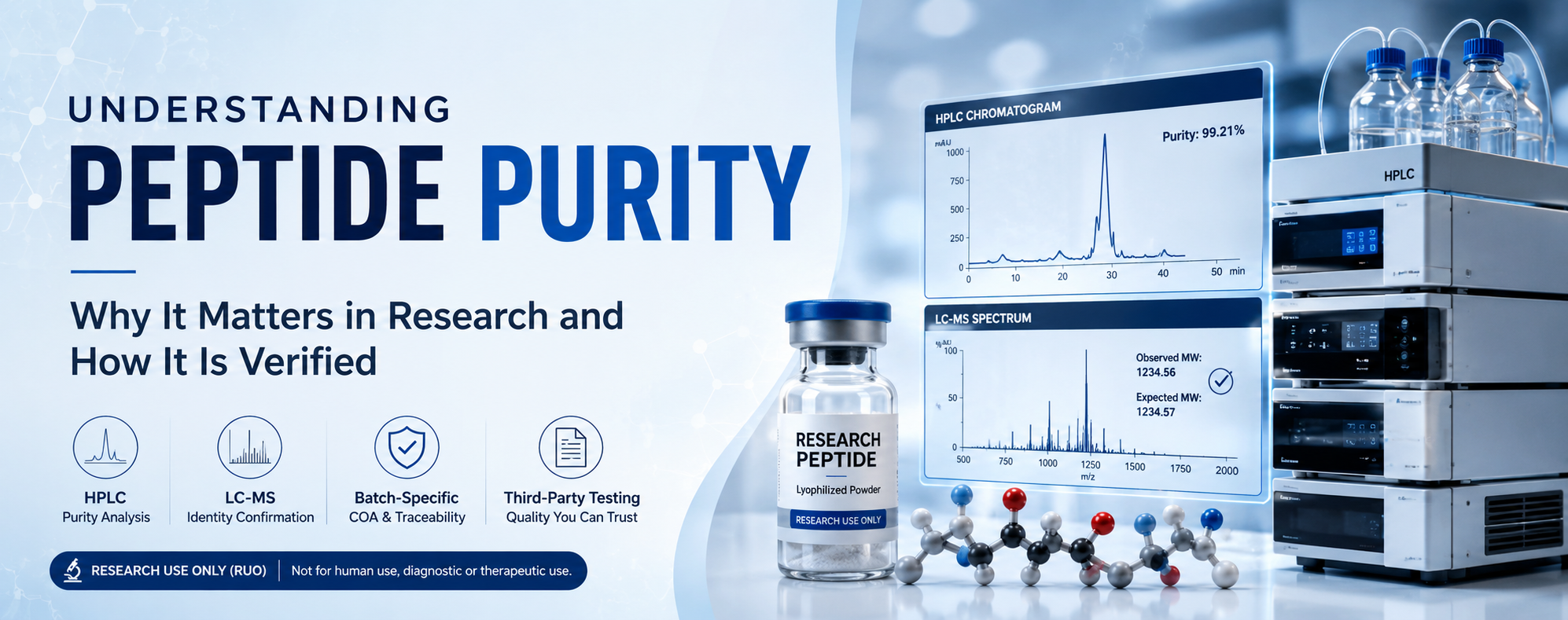
High-Performance Liquid Chromatography (HPLC)
- HPLC has been recognized as the standard method in purity testing in the industry.
- The peptide is introduced into a specific column in HPLC where different components are separated based on their properties.
- The separated components are registered using a detector as peaks in the output graph.
- Evaluation includes:
- Main peak area
- Retention time
- Impurity peaks
- The entire HPLC pattern
- The peak area of the main component defines the percent purity.
- Such as:
- Dominant main peak = high purity
- Several prominent peaks = low purity
- This method allows precise purity quantification.
- For further information, refer to:
Liquid Chromatography-Mass Spectrometry (LC-MS)
Whereas HPLC determines purity, LC-MS determines identity.
The mass spectrometer determines the molecular weight of the peptide and compares it against the theoretical one.
One can confirm:
- The identity of the molecule
- The molecular weight expected
- The sequence of the peptide
- The presence of any unknown molecules
This ensures that the main HPLC peak is that of the correct peptide and not that of some other molecule with similar chromatographic properties.
Why HPLC and LC-MS Are Used Together
Neither analytical method provides the complete picture alone.
| HPLC | LC-MS |
|---|---|
| Measures purity | Confirms molecular identity |
| Detects impurities | Confirms expected molecular weight |
| Produces chromatogram | Produces mass spectrum |
| Quantitative analysis | Structural verification |
Together they provide comprehensive analytical verification of research peptides.
Understanding an HPLC Chromatogram
While many scientists receive chromatograms along with COA, they do not know how to read these charts.
Normal chromatograms will contain:
- Retention time
- Peak area
- Peak height
- Percentage purity
- Analytical conditions
The ideal chromatogram would consist of:
- One peak
- Fewer secondary peaks
- Stable baseline
- Marked retention time
Several large secondary peaks may point to more impurities in the sample.
Common Sources of Peptide Impurities
Impurities can originate from several stages of production.
Examples include:
Incomplete Coupling
Some amino acids fail to attach during synthesis, producing shorter peptide fragments.
Oxidation
Exposure to oxygen can chemically modify susceptible amino acids.
Deamidation
Certain amino acids slowly convert into alternative forms over time.
Hydrolysis
Moisture exposure may gradually degrade peptide chains.
Storage Conditions
Improper temperature or repeated freeze-thaw cycles may reduce peptide integrity.
This is why appropriate Storage Guidelines are an essential part of quality assurance.
Understanding the Certificate of Analysis (COA)
A Certificate of Analysis is an official document providing proof that an individual batch has undergone testing.
The best COAs include:
- Product name
- Batch number
- Date of manufacture
- Date of analysis
- HPLC purity
- LC-MS identity verification
- Molecular weight
- LC-MS Chromatograms
- Laboratory Information
- Analyst approval
The use of Batch Specific COAs offers much higher transparency compared to general certificates since they pertain to a certain batch.
Batch-to-Batch Consistency
Even under strict control of manufacturing processes, there is still some possibility of variance among different batches.
The quality control laboratories reduce any possible variance through:
- SOPs
- Controlled synthesis
- Analytical testing
- Batch records
- Purification process
It is always recommended to confirm the consistency between the COA and the batch number mentioned on the label of the product.
Independent Third-Party Testing
Independent analytical laboratories are used by many research vendors.
Testing by third parties has multiple benefits:
- Independent validation
- Transparency
- Less bias
- Better documentation
- Research reliability
In addition to internal testing, independent HPLC and LC-MS testing provides another level of quality control.
Does Higher Purity Always Mean Better?
Certainly, increased purity is highly desired, but it constitutes just one of the many facets of quality. Researchers also need to consider:
- Molecular identity
- Batch traceability
- Storage conditions
- Manufacturing consistency
- Documentation
- Supplier reliability
A peptide claimed to be of high purity without any analytical support is less reliable compared to a peptide with complete batch-specific analytical support.
Peptide Purity and Research Reproducibility
Experimental reproducibility relies on having standardized experimental materials.
Good analysis assists scientists to:
- Compare experimental data across experiments
- Avoid unnecessary variables
- Gain more confidence in their experimental observations
- Maintain quality assurance
Laboratories conducting long-term research programmes gain scientific consistency from good analysis documentation.
Research Use Only
Research peptides are supplied strictly for laboratory and scientific research purposes.
They are not intended for human consumption, diagnosis, treatment or prevention of disease. Researchers should always follow institutional laboratory procedures and applicable regulatory requirements.
Related Articles
To help readers better understand peptide quality, consider exploring:
- How to Read a Peptide Certificate of Analysis (COA)
- HPLC vs LC-MS: What’s the Difference?
- Third-Party Peptide Testing Explained
- Storage Guidelines for Lyophilised Peptides
- How Peptides Are Manufactured
- Research Use Only (RUO): What It Means
Conclusion
Peptide purity is not simply a number that shows up on an item’s label but rather refers to the analysis conducted on peptides, which is essential for research quality and reproducibility. Being familiar with the way the purity of a peptide is determined using HPLC, as well as the method that is used to determine its molecular identity through LC-MS, helps to make a well-informed choice of research material.
Combining all of the above mentioned with a transparent production process and laboratory verification, researchers will have one of the best tools to ensure research grade quality.
Frequently Asked Questions
1. What does 99% peptide purity mean?
A purity of 99% means that about 99% of the peptide related compounds observed in analysis belongs to the intended peptide while the rest is made up of related impurities observed in the test.
2. Is HPLC enough to verify peptide quality?
No. HPLC is used to analyze the purity while LC-MS is typically utilized together with HPLC in order to determine molecular identity.
3. Why is a batch-specific COA important?
Batch-specific Certificate of Analysis shows that the specific batch of production has gone through analytical testing. This gives better traceability compared to general Certificates of Analysis.
4. Can peptide purity decrease over time?
Yes. Inappropriate storage, moisture contamination, freeze-thaw cycles and oxidation can impact on the stability of peptides, showing the need for storage as recommended.
5. Why do research laboratories value third-party testing?
Independent laboratories perform an objective analysis of analytical results.