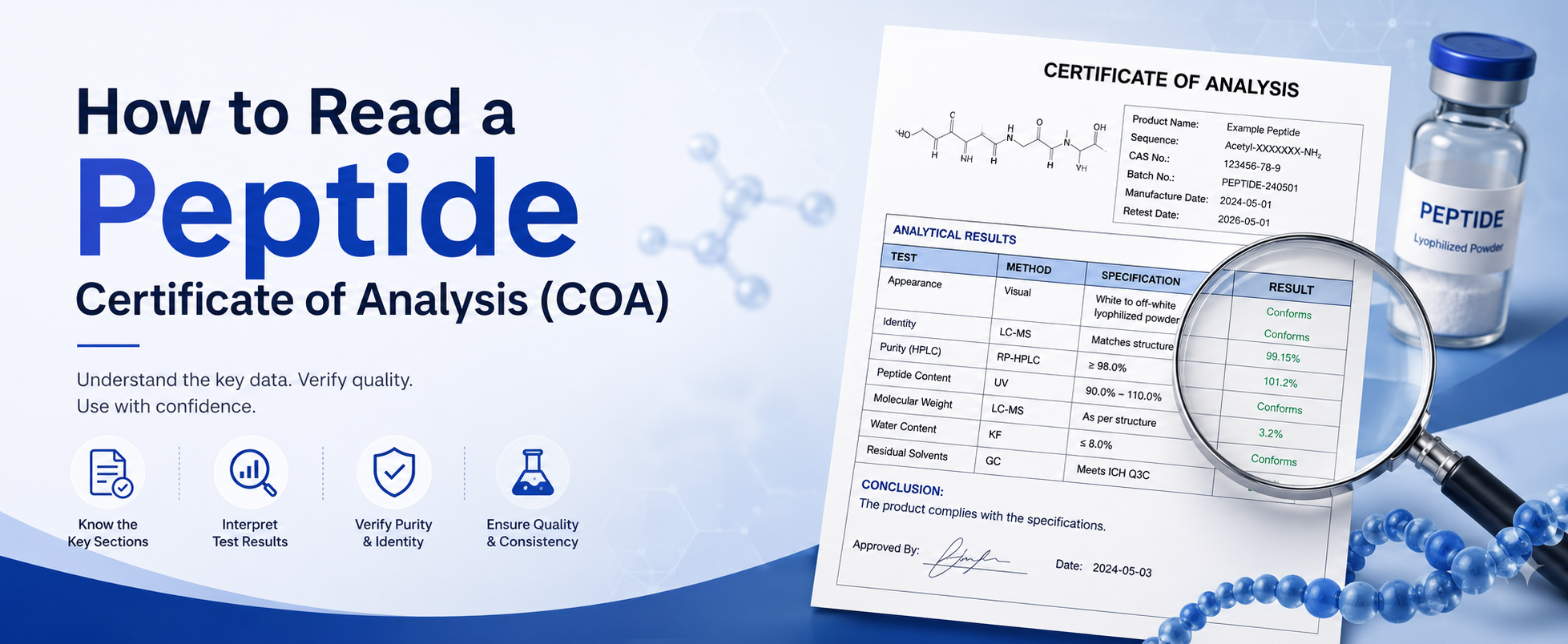
A Certificate of Analysis (COA) is the single most useful document attached to any research peptide. It is the lab report that tells you what is actually in the vial — how pure the peptide is, whether its identity has been confirmed, how much of the powder is peptide versus salt and water, and whether the batch passed the tests a supplier claims to run. Learning to read one turns a wall of numbers into a quick, confident yes-or-no on whether a batch matches what was ordered.
This guide walks through a COA section by section, in the order it usually appears, and explains what each figure means in practice. It is written for a technical audience evaluating material for laboratory research use only. Nothing here is guidance on human or animal use.
The 30-second version
If you only check four things, check these: (1) the purity by HPLC – look for ≥98% and an actual chromatogram; (2) the identity by mass spectrometry — observed mass should match the theoretical mass; (3) the batch / lot number — it must match the vial in your hand; and (4) that the COA is batch-specific and dated, not a generic template reused for every order.
What a COA actually is
A COA is a summary of analytical tests run on a specific batch of material. For peptides, those tests are dominated by two techniques: high-performance liquid chromatography (HPLC), which measures purity, and mass spectrometry (MS), which confirms identity. Everything else on the page — water content, counterion content, appearance, endotoxin levels — supports those two headline numbers.
The important distinction is who ran the tests. A third-party (independent) COA comes from an accredited analytical lab with no stake in the result and carries far more weight than an in-house COA produced by the manufacturer or reseller themselves. Neither is automatically worthless, but an independent report on the exact batch you received is the gold standard. A generic in-house sheet with no batch number and no chromatogram is close to meaningless.
1. The header / identity block
The top of the COA identifies the material. Read every line here against your order and your vial before looking at any test results — a beautiful purity figure for the wrong compound helps no one.
| Field | What it means | What to check |
|---|---|---|
| Product / peptide name | The common or trade name of the peptide. | Matches what you ordered. |
| Sequence | The amino-acid sequence in single- or three-letter code. | Matches the known sequence for that peptide. |
| Molecular formula | The empirical chemical formula. | Consistent with the sequence. |
| Molecular weight (MW) | The theoretical mass in g/mol (Daltons). | Used later to check the MS result. |
| CAS number | Chemical Abstracts registry ID, where one exists. | Cross-references the exact compound. |
| Batch / lot number | Unique ID for this production run. | Must match the label on your vial. |
| Manufacture & retest/expiry date | When it was made and when it should be re-checked. | Recent, and not past its retest date. |
| Appearance | Expected physical form, e.g. white lyophilised powder. | Matches what is in the vial. |
Why the batch number matters most
A COA describes one batch. If the lot number on the certificate does not match the lot number printed on your vial, the report tells you nothing about the material you are holding — no matter how good the numbers look. This is the single most common way a genuine-looking COA becomes irrelevant.
2. Purity by HPLC (the headline number)
HPLC purity is the figure most people mean when they ask “how pure is it?” It is usually expressed as a percentage — for example, Purity (HPLC): 99.1%. The technique separates the components of the sample by pushing it through a column; each component leaves at a different time and registers as a peak on a chromatogram. The purity figure is the area of the main peak as a percentage of the total area of all peaks.
In other words, 99.1% purity means the target peptide accounts for 99.1% of the detectable material, and everything else — truncated sequences, deletion products, other impurities — makes up the remaining 0.9%.
What is a good number?
- ≥98% — the standard benchmark for research-grade peptides. Most reputable suppliers target this.
- 99%+ — excellent; common for well-established, easily synthesised sequences.
- 95–97% — acceptable for some difficult or longer sequences, but ask why it isn’t higher.
- <95% — below the usual research standard; treat as a flag, not a pass.
Read the chromatogram, not just the number
A purity percentage typed onto a page is only as trustworthy as the chromatogram behind it. A genuine COA includes the actual HPLC trace. When you look at it:
- There should be one dominant, sharp peak (the target peptide), usually eluting at a stated retention time.
- Small peaks near the baseline are minor impurities — normal in tiny amounts. A cluster of large secondary peaks is not.
- The baseline should be flat and stable, not wandering or noisy.
- Axes should be labelled, with the method and column (e.g. C18 reverse-phase, gradient, UV detection at 214/220 nm) stated somewhere on the report.
Red flag
A purity figure with no chromatogram attached, or a chromatogram that is a blurry, cropped, or obviously reused image, is a warning sign. Anyone can type “99%” into a document. The trace is the evidence.
3. Identity by mass spectrometry (MS)
Purity tells you how much of the sample is a single compound. It does not, on its own, tell you which compound. That is the job of mass spectrometry, which measures the molecular mass of the peptide and compares it to the theoretical value calculated from the sequence.
On the COA you will see a theoretical (expected) mass and an observed (found) mass. These should agree very closely. Because peptides are often detected as charged species (e.g. [M+H]⁺ or [M+2H]²⁺), the observed value may correspond to the molecule plus one or more protons — a good report labels which ion it is reporting.
| On the COA | Meaning |
|---|---|
| Theoretical MW: 1419.5 | Mass calculated from the amino-acid sequence. |
| Observed: 1419.7 (or 1420.5 [M+H]⁺) | Mass actually measured; should match within a small tolerance. |
| Method: ESI-MS / MALDI-TOF | The ionisation / analyser technique used. |
If the observed mass matches the theoretical mass and the HPLC purity is high, you have strong evidence that the vial contains a lot of the right peptide. A COA with purity but no identity confirmation is only telling you half the story.
4. Net peptide content (what you’re really weighing)
This is the section most often overlooked, and it explains a lot of apparent discrepancies. A lyophilised (freeze-dried) peptide powder is not 100% peptide. It also contains water and counterions (salts) bound up during synthesis and purification. So a vial labelled “10 mg” refers to the total powder weight — the actual peptide inside is less.
Net peptide content (also called peptide content or peptide assay) is the percentage of the powder that is genuinely peptide. A typical figure is 70–90%. The rest is water and salt. This is normal and not a defect — but it matters for anyone doing quantitative work, because it is the difference between gross weight and actual peptide mass.
Worked example
A vial states 10 mg net weight and a peptide content of 80%. The actual peptide present is 10 mg × 0.80 = 8 mg. The remaining 2 mg is water and counterion. If your calculations assume 10 mg of pure peptide, you will be off by 20%.
5. Counterion and water content
Counterion (salt form)
Peptides are usually supplied as a salt. The two most common counterions are trifluoroacetate (TFA) and acetate. TFA is a residue of the purification process; acetate salts are produced by an extra salt-exchange step. The COA may list the counterion type and, sometimes, its percentage. This is part of what makes up the non-peptide fraction discussed above.
Water / moisture content
Lyophilised powders retain some water. Water content (often measured by Karl Fischer titration) is typically a few percent. It is reported both because it affects the net peptide figure and because excess moisture can shorten shelf life. A very high water figure is worth questioning.
6. The supporting tests
Depending on the peptide and its intended application, a COA may include further tests. Not every peptide needs all of these, but their presence signals a more rigorous lab.
| Test | What it measures | Why it appears |
|---|---|---|
| Endotoxin (LAL) | Bacterial endotoxin levels, in EU/mg. | Relevant for cell-culture and sensitive assays. |
| Sterility / bioburden | Presence of microbial contamination. | For material that must be low-bioburden. |
| Heavy metals | Trace metal contaminants. | Purity and safety of the source material. |
| Residual solvents | Leftover solvents from synthesis. | Quality of the purification process. |
| Solubility | Recommended solvents / behaviour. | Practical handling information. |
| Optical rotation | Confirms correct stereochemistry. | Rarely, for chirality-sensitive work. |
The absence of these does not automatically condemn a COA — they are context-dependent. But a report that includes relevant ones is generally a sign of a more thorough analytical process.
7. How to spot a weak or fake COA
A COA is only as good as its provenance. Use this checklist to separate a genuine, batch-specific report from a decorative one:
- No batch/lot number, or a lot number that doesn’t match your vial.
- No chromatogram or spectrum — just typed percentages with nothing behind them.
- Purity but no identity (HPLC present, MS missing), or vice versa.
- No dates of manufacture or testing, so you can’t tell how old the material is.
- Reused images — the same chromatogram appearing on COAs for different compounds or batches.
- No issuing lab identified, no method details, and no contact or accreditation information.
- Impossibly perfect numbers (e.g. “100.0%” purity) with no supporting trace.
- A generic template that is clearly reused verbatim across every product on a site.
Best practice
Where possible, ask for a recent, independent, batch-specific COA for the exact lot you are buying, and confirm the lot number on the certificate matches the vial before use. A supplier that provides this readily is demonstrating exactly the transparency you want.
Quick reference: the read-through checklist
- Identity block — name, sequence and formula match the order.
- Batch number — matches the vial in hand.
- Dates — recent manufacture, within retest window.
- HPLC purity — ≥98%, with a clean chromatogram showing one dominant peak.
- MS identity — observed mass matches theoretical mass.
- Net peptide content — noted, and factored into any quantitative work.
- Counterion & water — reasonable, and consistent with the peptide content figure.
- Supporting tests — present where the application requires them.
- Provenance — independent, batch-specific, with method and lab identified.
Glossary of terms
| Term | Definition |
|---|---|
| COA | Certificate of Analysis — the batch-specific lab report summarising test results. |
| HPLC | High-Performance Liquid Chromatography — separates components to measure purity. |
| Chromatogram | The graphical output of an HPLC run; peaks represent detected components. |
| Retention time | How long a component takes to travel through the column and register as a peak. |
| MS | Mass Spectrometry — measures molecular mass to confirm identity. |
| ESI / MALDI | Two common ionisation methods used in peptide mass spectrometry. |
| Net peptide content | The percentage of the powder that is actual peptide, excluding water and salt. |
| Counterion | The salt (commonly TFA or acetate) paired with the peptide. |
| Karl Fischer | A titration method for measuring water/moisture content. |
| Endotoxin (LAL) | A test for bacterial endotoxin, reported in endotoxin units per mg. |
| Lyophilised | Freeze-dried; the usual physical form of a supplied peptide powder. |
For research use only. This article is educational information about interpreting analytical documents and is not medical, veterinary, or professional advice. It does not describe or endorse the use of any peptide in humans or animals. Regulatory status varies by jurisdiction – verify the applicable rules in your region before purchasing or handling any material.