The role of peptides in today’s biological and pharmacological science has gained immense importance. These compounds are used by scientists for research into cell signalling, protein–protein interactions, metabolism and many other biological phenomena.
Despite being smaller than proteins, the manufacture and characterisation of high-grade research peptides require advanced technologies, stringent quality controls and thorough analysis.
At PeptidesX, each research peptide is exclusively intended for Research Use Only (RUO) and provided with batch-specific quality information, including a Certificate of Analysis (COA) and third-party analytical testing.
Below we provide detailed information on peptide manufacturing, purification and analysis.
What Are Peptides?
Peptides are composed of short chains of amino acids joined by peptide bonds. While proteins can be made up of several hundred amino acids or more, peptides are typically comprised of anywhere between two and fifty amino acids.
Being small enough for synthesis in the laboratory, yet sufficient to study many biological processes, peptides offer a number of advantages.
The Peptide Manufacturing Process
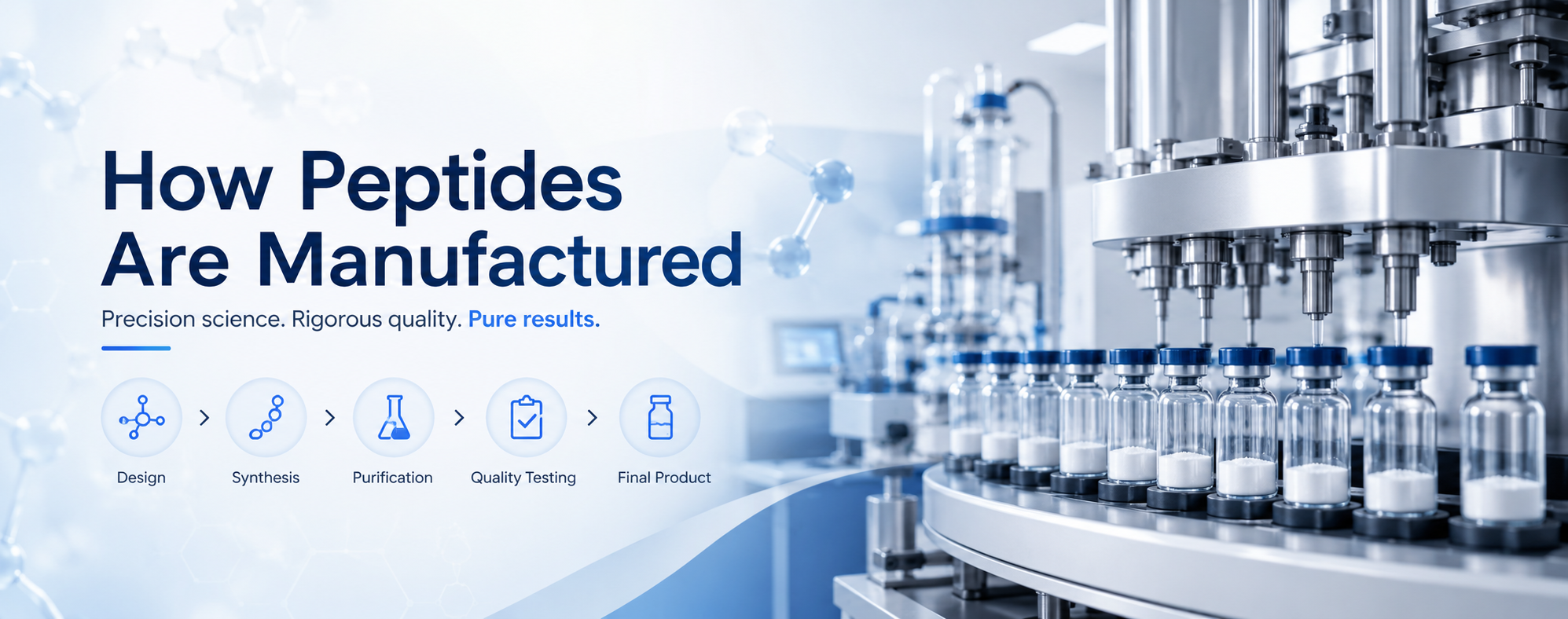
Modern peptide production involves several carefully controlled stages.
Step 1: Peptide Design
Everything begins with a specific amino acid sequence. Researchers determine:
- Desired peptide sequence
- Length
- Molecular weight
- Terminal modifications
- Purity requirements
- Intended laboratory application
Computer software often helps verify the sequence before manufacturing begins.
Step 2: Selecting Raw Materials
Manufacturing starts with pharmaceutical- or research-grade amino acids. Each amino acid must meet strict specifications for:
- Identity
- Chemical purity
- Stability
- Moisture content
- Contaminant limits
Using high-quality raw materials helps ensure consistent peptide synthesis.
Step 3: Solid-Phase Peptide Synthesis (SPPS)
Today, almost all research peptides are produced using Solid-Phase Peptide Synthesis (SPPS). This technique revolutionised peptide chemistry and remains the industry standard. The process involves:
Resin Attachment
The first amino acid is attached to an insoluble resin bead. The resin acts as a solid support throughout synthesis.
Amino Acid Coupling
Protected amino acids are added one at a time. Each cycle includes:
- Deprotection
- Washing
- Coupling
- Verification
This process repeats until the full peptide sequence has been assembled. Modern automated peptide synthesisers can perform hundreds of coupling cycles with exceptional precision.
Side-Chain Protection
Many amino acids contain reactive side groups. Temporary protecting groups prevent unwanted chemical reactions during synthesis. Once assembly is complete, these protecting groups are removed.
Step 4: Cleavage from the Resin
After synthesis is complete, the peptide is separated from the resin. Special chemical reagents simultaneously:
- Release the peptide
- Remove protecting groups
- Produce the crude peptide
At this stage, impurities may still be present.
Step 5: Purification
Purification is one of the most critical stages of peptide manufacturing. Even highly efficient synthesis generates small amounts of:
- Truncated peptides
- Deleted sequences
- Oxidised products
- Side products
- Unreacted amino acids
These impurities must be removed before the peptide can be supplied for research.
Reverse-Phase HPLC
The most common purification technique is High-Performance Liquid Chromatography (HPLC). During HPLC:
- Peptides pass through a specially designed column.
- Molecules are separated based on their chemical characteristics.
- Fractions are collected individually.
- The required peptide is purified.
The purity level for high-quality research peptides is usually above 98–99%. To learn more, scientists may refer to the Quality & Testing and HPLC vs LC-MS Testing guides provided by PeptidesX.
Step 6: Lyophilisation (Freeze Drying)
After purification, peptides remain in solution. To improve stability, they undergo freeze drying. The solution is:
- Frozen
- Subjected to vacuum
- Dried as water is removed through sublimation
The final product becomes a dry, white lyophilised powder. Lyophilised peptides generally offer improved stability during storage and transportation compared with aqueous solutions.
Step 7: Quality Control Testing
Before any batch can be released, extensive analytical testing is performed. Common tests include:
HPLC Purity Analysis
Confirms overall purity. Measures:
- Main peak percentage
- Impurity profile
- Chromatographic consistency
LC-MS (Mass Spectrometry)
Mass spectrometry verifies:
- Molecular identity
- Expected molecular weight
- Structural confirmation
Together, HPLC and LC-MS provide complementary information about peptide quality and identity.
Additional Laboratory Testing
Depending on the peptide and supplier, further analyses may include:
- Moisture analysis
- Appearance analysis
- Solubility analysis
- Endotoxin test
- Heavy metals analysis
- Residual solvent test
- Stability test
An independent third-party laboratory can sometimes be used for this purpose.
Certificate of Analysis (COA)
After the successful completion of testing, a Certificate of Analysis (COA) is prepared by the manufacturing company. A typical batch-related COA contains:
- Product name
- Batch number
- Manufacturing date
- Testing methods
- HPLC purity
- LC-MS identity confirmation
- Molecular weight
- Appearance
- Pass/Fail status
Because the COA pertains to an individual production batch, it provides traceability and documentation for laboratory researchers. Researchers who wish to understand how to read COA reports may refer to How to Read a COA in the PeptidesX Knowledge Centre.
Packaging Standards
After testing, approved batches are taken for packaging. Packaging normally involves:
- Sterilised laboratory vials
- Safe sealing
- Batch labelling
- Product labels
Good packaging helps prevent contamination of the peptide from:
- Humidity
- Light
- Exposure to air
- Physical damage
Storage Guidelines
Quality control in manufacturing is not limited to synthesis alone. Proper storage helps preserve peptide structure. Some general guidelines are:
- Store lyophilised peptides in a cool, dry environment.
- Avoid exposure to direct sunlight.
- Limit freeze–thaw cycles after reconstitution.
- Adhere to the specific manufacturer’s storage instructions.
Storage conditions may differ from one peptide sequence to another. More details can be found on the Storage Guidelines page of the PeptidesX website.
Why Manufacturing Quality Matters
An amino acid sequence is just one characteristic that indicates the quality of a peptide product. Valid research requires, among other things:
- Exact molecular identification
- A high degree of purity
- Consistent batches
- Sound analytical confirmation
- Thorough documentation
- Appropriate packaging
- Suitable storage
High standards of production increase the reproducibility of results.
Modern Advances in Peptide Manufacturing
Manufacturing technology keeps progressing. The latest advances include:
- Advanced peptide synthesis machines
- Continuous-flow synthesis
- Improved coupling chemistry
- Better purification systems
- Peptide sequences optimised via AI
- State-of-the-art analytical equipment
Such advancements make manufacturing more efficient and facilitate peptide studies.
Choosing a Reliable Research Peptide Supplier
When considering research peptide suppliers, researchers should pay attention to more than marketing claims. Key factors include:
- Independently conducted HPLC analysis
- Identity confirmation by LC-MS analysis
- A Certificate of Analysis per batch
- Transparent quality documentation
- A specific “Research Use Only” disclaimer
- Batch traceability
- Publication of the testing protocol
Transparency and testing are becoming the main quality indicators in this industry.
Conclusion
Peptide production is a sophisticated process involving chemistry, synthesis automation, purification technology and analytical testing. From the precise selection of amino acids to Solid-Phase Peptide Synthesis, and from purification and lyophilisation to quality control testing, each step ensures that the peptides produced are suitable for scientific research.
By learning about the peptide manufacturing process, researchers can grasp the significance of batch-specific testing, proper documentation and quality assurance. Understanding topics such as Quality & Testing, the Certificate of Analysis (COA), Packaging Standards, Storage Instructions and Research Use Only provides valuable insight into evaluating research-grade peptides.
At PeptidesX, all products are provided exclusively for laboratory research and backed by analytical documentation.