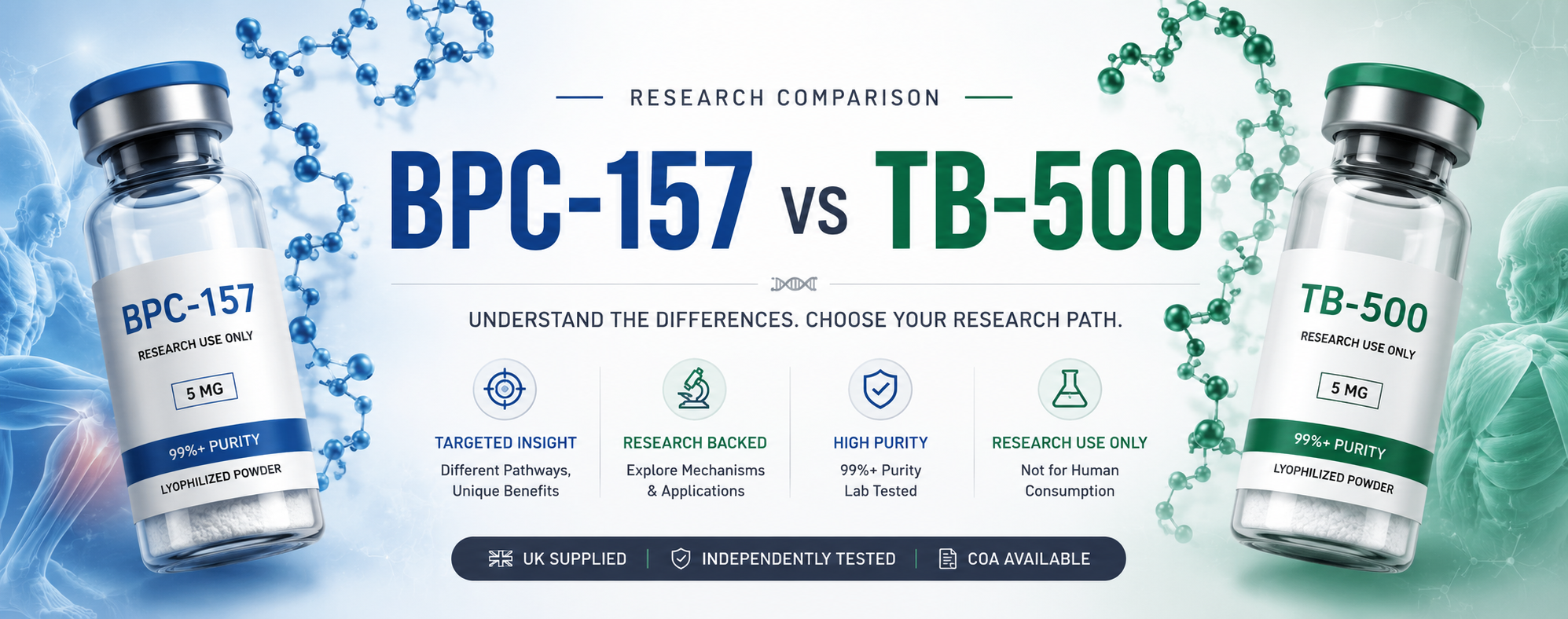
The BPC-157 and TB-500 peptides are two peptides that are constantly mentioned when talking about tissue repair and regenerative medicine research, and both of them are always mentioned side by side. Both have generated tremendous preclinical amount of knowledge regarding the wound repair, angiogenesis and musculoskeletal regeneration, and both peptides are commonly used together for preclinical experiments. Nevertheless, even though these two peptides are similar in terms of what kind of topics they are associated with, both peptides are completely unrelated molecules that work via different biological mechanisms.
In this article, we will see from where these molecules originate, how are they thought to work at the cellular level, what kind of scientific background is there for these molecules, and why are these two peptides different from one another.
Quick Comparison at a Glance
| Attribute | BPC-157 | TB-500 |
|---|---|---|
| Origin | Fragment of a human gastric juice protein (BPC) | Synthetic fragment of Thymosin Beta-4 (Tβ4) |
| Structure | Pentadecapeptide — 15 amino acids | ~17-amino-acid active fragment (some sources use the full 43-mer synthetic sequence) |
| Primary studied mechanism | Multi-pathway cytoprotection and VEGFR2-driven angiogenesis | G-actin sequestration regulating cell migration |
| Key signalling associations | VEGF/VEGFR2, NO–eNOS axis, FAK-paxillin, Egr-1 | Actin cytoskeleton dynamics, downstream angiogenesis and anti-inflammatory signalling |
| Notable stability feature | Reported resistance to gastric proteolysis | High aqueous solubility; no demonstrated oral activity |
| Strongest evidence areas | Gastrointestinal, tendon/ligament, bone, neural models | Cardiac remodelling, dermal wound repair |
| Plasma half-life (rodent models) | Short (reported under ~30 minutes in some studies) | Approximately 2–3 hours |
| Regulatory status | Not approved for human use; research compound only | Not approved for human use; research compound only |
What Is BPC-157?
BPC-157 (Body Protection Compound-157) is a synthetic pentadecapeptide, consisting of 15 amino acid units, extracted from a fragment of a protective protein contained in human gastric juice. This peptide is among the best-studied ones in the cytoprotection area, having extensive pre-clinical history since the early 1990s with experiments conducted using the models of injuries in different organs in various animals.
One of the unique properties of BPC-157 is the presence of triple proline core, believed to be responsible for its extraordinary stability to proteolysis. Proteolytic stability is often given as an explanation why BPC-157 was under investigation in several ways of administration in animal researches, and why this compound is often mentioned as resistant to degradation in acidic environment, where other peptides decompose easily. It should be mentioned that pharmacokinetic studies still report relatively short half-life of the substance in blood circulation.
Human evidence, by contrast, remains very limited. Only a small number of pilot studies have examined BPC-157 in people, and controlled clinical data are scarce though this is an evolving area, with at least one registered placebo-controlled Phase 2 study of BPC-157 in acute muscle-strain recovery now on record.
What Is TB-500?
TB-500 is a synthetic peptide based on the active region of Thymosin Beta-4 (Tβ4), a naturally occurring 43-amino-acid protein that is among the most abundant actin-binding molecules in mammalian cells. Native Tβ4 was first isolated from calf thymus by Allan Goldstein and colleagues in 1981, and its role later expanded far beyond immunology once its actin-regulating function was recognised.
There is an important nomenclature nuance here that researchers should be aware of. In much of the literature, “TB-500” refers specifically to the ~17-amino-acid fragment containing the LKKTETQ actin-binding motif — the minimal sequence responsible for Tβ4’s cytoskeletal activity. However, some suppliers use the “TB-500” label for a full-length synthetic version of the 43-residue peptide. Because the two are not identical, confirming the exact amino acid sequence on the Certificate of Analysis (COA) is essential before any comparative work.
Whereas BPC-157 has not been shown to be resistant to stomach digestion, no studies have proven its oral activity; the existing pre-clinical protocols use either injections or topical administration of the compound. The half-life time of TB-500 in rodents amounts to about two to three hours; however, the effect on migration of cells persists for much longer after the clearance of the peptide from the plasma.
Mechanisms of Action: The Core Difference
This is where the two compounds genuinely diverge. They are often grouped together because their observed outcomes in repair models overlap, but the molecular routes to those outcomes are distinct.
BPC-157: Multi-Pathway Cytoprotection
The BPC-157 literature describes a peptide that appears to act on several pathways at once rather than through a single receptor. The most consistently reported mechanisms include:
- VEGFR2-mediated angiogenesis. Pre-clinical research has reported an increase in VEGF and its receptor VEGFR2, and enhanced migration of endothelial cells; both of these are essential for angiogenesis. Enhanced vascularization is consistently observed in the treated tissue in both wound healing and musculoskeletal injuries models.
- Nitric oxide (NO) modulation. The association between BPC-157 and the NO-eNOS pathway has often been made in relation to its effects on endothelial nitric oxide formation. NO regulates blood vessel tone, platelet function, and perfusion, among other things, and the NO-eNOS pathway is often considered the major mediator of BPC-157’s vascular actions.
- FAK-paxillin signalling. The pathway regulates endothelial cell migration, an important step in angiogenesis.
- Additional survival and transcriptional signalling. It is involved in the signaling for survival and transcription through associations with the Egr-1 transcription factor and Akt/PI3K cell survival pathway.
One of the aspects of BPC-157 that is often mentioned in various reviews is the fact that the compound shows bidirectional or balancing effects, apparently having an effect on stabilisation of systems rather than moving them in one direction. However, at the same time, the reviews do note the absence of some data, particularly the lack of information on higher doses.
TB-500: Actin Regulation and Cell Migration
The mechanism of action of TB-500 is simpler and more upstream. Its main function is G-actin sequestration, which means that the peptide binds monomeric actin, controlling the ratio of free actin monomers (G-actin) and polymerized fibers (F-actin).
How does it help? Actin dynamics underlie all processes in the cell involving mechanical functions. Upon reception of a signal to migrate – such as chemical mediators called chemokines present near the edge of the wound – the bound pool of actin monomers becomes immediately available to form actin filaments in the lamellipodium and filopodia of migrating cells. In other words, by maintaining the supply of available actin monomers, TB-500 provides a fast reaction for cell movement in the direction of the signal to migrate.
Cell migration is an upstream process of wound healing, angiogenesis, and remodeling. This explains how the effect of one mechanism affects the results of TB-500 in research papers – migration of endothelial cells, tube formation, stabilization of vessels, and anti-inflammatory signaling. Experiments confirmed that the amino acid sequence LKKTET was responsible for angiogenesis, since mutagenesis of the motif severely decreased the efficiency of Tβ4 in forming vessels.
Research Applications Compared
Because the mechanisms differ, the two compounds have accumulated their strongest evidence in somewhat different areas — with meaningful overlap in wound healing and angiogenesis.
Gastrointestinal research is heavily weighted toward BPC-157, reflecting its origin as a gastric-derived peptide. It features prominently in models of gastric and intestinal injury, where the cytoprotection concept was first developed.
Tendon, ligament and bone models are again a BPC-157 stronghold. Studies in medial collateral ligament repair and segmental bone-defect models have reported earlier restoration of structural integrity, better-organised collagen architecture and accelerated callus formation — effects consistent with enhanced local vascularisation.
Cardiac research tilts the other way. TB-500 (and full Tβ4) has a more developed preclinical cardiac evidence base than BPC-157, particularly in post-myocardial-infarction remodelling models, supported in part by NIH-funded investigation. For cardiac-focused work, TB-500 tends to be the primary research peptide of the two.
Dermal wound healing is common ground. Both peptides have been associated with accelerated wound closure and improved tissue quality in rodent models — BPC-157 largely via angiogenesis and fibroblast activity, TB-500 via keratinocyte and endothelial migration.
Neural tissue is an emerging BPC-157 area, where its NO-modulating and neuroprotective properties are under active investigation.
Practical Differences That Matter in the Lab
Beyond mechanism, several practical distinctions come up whenever the two are compared:
- Stability and route. BPC-157’s reported acid stability means it has been studied across multiple administration routes in animal models. TB-500 has no demonstrated oral activity and appears in the literature almost exclusively via injectable or topical routes.
- Half-life profile. BPC-157 shows a short plasma half-life but often more sustained tissue-level effects; TB-500 has a longer plasma half-life (~2–3 hours) with downstream migratory effects that outlast the peptide itself.
- Breadth vs specificity. BPC-157’s appeal in research is its pleiotropy — a wide range of effects from one compound. TB-500’s appeal is the opposite: a clean, well-defined mechanism centred on a single, well-characterised protein family.
- Sequence verification. The BPC-157 sequence is consistent across the literature. TB-500 is not — always confirm the exact sequence (17-mer active fragment vs full 43-mer) on the COA before designing comparative experiments.
Are They Studied Together?
Yes, quite often. Since BPC-157 and TB-500 function via mechanisms that do not overlap at all, the former having a broad spectrum of cytoprotection and angiogenesis, while the latter is related to cell migration, they are usually considered as complementing each other in the scientific literature and are often studied together for tissue regeneration purposes. The idea behind this is that the two proteins target different steps of the regeneration process, one being migration and mobilization of the cytoskeleton, and the other one being vascularization and cytoprotection. However, it should be noted that there is no solid evidence about this matter.
Handling and Storage
Both peptides are generally available as a freeze-dried (lyophilized) powder. The general procedure followed in the laboratory for this type includes reconstitution with bacteriostatic or sterile water, storage of the lyophilized powder under cool and dark conditions, and storing the reconstituted solution under cold temperatures to avoid repetitive freeze-thaw cycles and light. TB-500, in particular, is well known for its high solubility in water, making it easy to dissolve. It is always advisable to stick to the recommended storage conditions as indicated on the COA of the product.
Regulatory and Research Status
Both BPC-157 and TB-500 have not been approved for human use by the MHRA, and similar agency, because there is no adequate clinical data on them on a large scale. They are purely research chemicals.
In terms of anti-doping regulations, it is worth mentioning that the rules are evolving, as BPC-157 was included in the WADA monitoring/prohibited list in 2022 on a temporary basis. Everyone engaged in sports-related activities must consult the WADA Prohibited List each year.
Conclusion
The frequency with which BPC-157 and TB-500 are compared makes it very easy to assume that the former is merely a variant on the latter. It is not. BPC-157 is a pentadecapeptide derived from the stomach that operates via an intricate network of cytoprotection and angiogenesis mechanisms, including VEGFR2, NO-eNOS signaling, FAK-paxillin interaction and others, with its most solid data being derived from gastrointestinal, tendon, ligament, bone, and increasingly neural studies. TB-500 is a fragment of the actin modulator Thymosin Beta-4 that operates through a single elegant pathway, namely G-actin sequestration, with its main mechanism of action being cell migration for wound healing, especially cardiological and dermatological.
For scientists, the decision as to which peptide to use lies in the mechanism of action: a multi-faceted protection mechanism or specific regulation of cell migration. Understanding the difference is the way to correctly interpret the scientific literature on both peptides and design experiments that will reflect their differences on a molecular basis.
Important Disclaimer. The information provided on this website is meant only for academic and informational purposes. None of the information on this page can be taken to mean any medical advice or dosage instruction or prescription for human or animal usage. All products provided by PeptidesX are to be used only for in vitro research applications and are not for any form of human ingestion, medical or veterinary application, or therapeutic use.