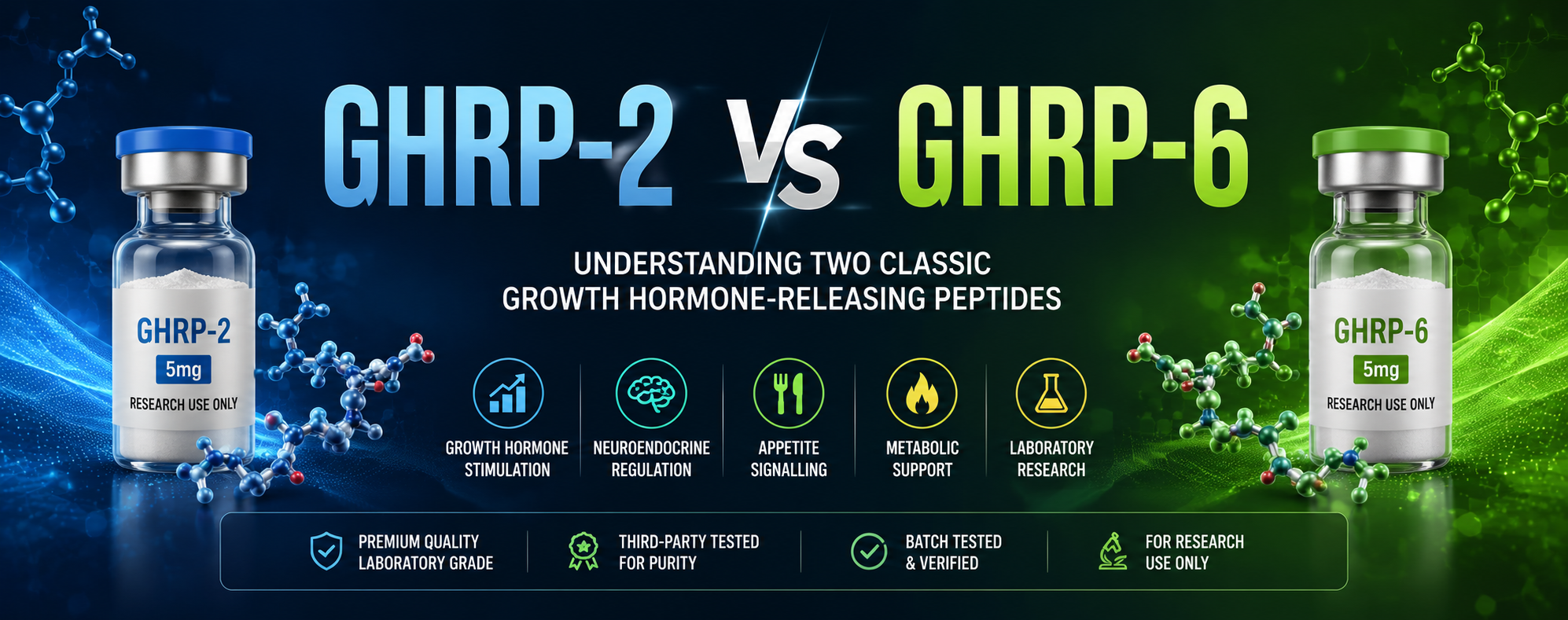
For decades, growth hormone-releasing peptides (GHRPs) have been a subject of endocrine and metabolic studies. Two of the first and most studied growth hormone-releasing hexapeptides are GHRP-2 and GHRP-6 — synthetic compounds that activate the GHS-R1a receptor to induce endogenous growth hormone release.
Though the two molecules target the same receptor and share a similar chemical structure, there is enough laboratory evidence to distinguish their effects on the receptor, hormone levels, appetite control and scientific applications. Those differences make GHRP-2 and GHRP-6 valuable to researchers studying growth hormone and metabolism.
This guide examines the two compounds from a scientific point of view, strictly for research purposes only.
What Are GHRP-2 and GHRP-6?
GHRP-2 and GHRP-6 belong to a class of synthetic peptides called growth hormone secretagogues. Unlike recombinant growth hormone, these molecules do not act as replacements for growth hormone. Instead, they target the receptors responsible for the physiological processes of growth hormone release.
Both peptides bind mainly to the Growth Hormone Secretagogue Receptor (GHS-R1a), better known as the ghrelin receptor. Activation of this receptor plays a role in several physiological pathways under investigation today:
- Growth hormone secretion
- Neuroendocrine regulation
- Appetite signalling
- Energy metabolism
- Gastrointestinal physiology
- Pituitary hormone secretion
According to scientific research, these two peptides trigger the secretion of growth hormone by activating the same receptor pathway despite their different structures.
Molecular Comparison
| Characteristic | GHRP-2 | GHRP-6 |
|---|---|---|
| Peptide family | Growth Hormone-Releasing Peptide | Growth Hormone-Releasing Peptide |
| Length | Hexapeptide | Hexapeptide |
| Primary receptor | GHS-R1a | GHS-R1a |
| Growth hormone stimulation | Higher in many experimental models | Strong |
| Appetite signalling | Moderate | More pronounced |
| Research history | Extensive | Extensive |
Although both compounds bind the same receptor, their downstream biological responses differ in several important ways.
Mechanism of Action
Both act through stimulation of the GHS-R1a receptor, located in the hypothalamus and the anterior pituitary gland. Stimulation initiates intracellular signalling pathways that cause pulsatile growth hormone release. Because this method relies on internal physiological processes rather than direct hormone administration, GHRPs are useful instruments in endocrine regulation research.
Research has found that:
- The receptor actions of GHRP-2 and GHRP-6 are the same.
- Both show synergy with Growth Hormone Releasing Hormone (GHRH).
- Combined use of the two does not increase growth hormone release, as they compete at the same receptor.
GHRP-2: Research Characteristics
GHRP-2 was formulated as a second-generation analog aimed at refining the original compound, GHRP-6. It is commonly studied because:
- It elicits potent growth hormone secretion
- Receptor affinity is higher
- It stimulates appetite only moderately
- The endocrine response is relatively stable
A defining characteristic is its ability to induce strong growth hormone pulses while producing weaker hunger signals than GHRP-6. Current areas of study include:
- Growth hormone physiology
- Endocrine feedback control
- Pituitary signalling
- Metabolic control
- Hormonal aging
GHRP-6: Research Characteristics
GHRP-6 is one of the first growth hormone-releasing peptides ever discovered and is still heavily cited in the peptide literature. Despite being highly potent at inducing growth hormone secretion, its interactions with appetite pathways are often highlighted by scientists.
Experimental studies involving GHRP-6 include:
- Ghrelin receptor binding
- Increased feeding behaviour in the model
- Growth hormone secretion
- Neuroendocrine signalling
- Gastrointestinal hormones
Because of these properties, GHRP-6 is preferred for studies involving appetite-pathway signalling alongside growth hormone secretion.
Appetite Signalling Differences
Perhaps the most recognised difference between the two peptides relates to the regulation of appetite.
GHRP-2
Laboratory research tends to suggest:
- Moderate stimulation of appetite
- Limited effect on hunger levels
- Effective GH secretagogue
GHRP-6
Experimental research tends to show:
- High stimulation of appetite
- High levels of ghrelin-like action
- Increase in feeding behaviour
This difference may result from slight variations in receptor actions, although both peptides bind to the same GHS-R family of receptors.
Growth Hormone Release
Growth hormone secretion remains the chief reason these peptides are so interesting to study. According to scientific literature, GHRP-2 triggers relatively higher peak GH responses under certain laboratory conditions, while GHRP-6 induces lower but dependable results.
Factors under investigation include:
- Peak GH secretion
- Duration of pulses
- Receptor sensitivity
- Hormonal feedback
- Interaction with GHRH analogs
It is worth noting that the magnitude of these responses depends heavily on the methodology used and the animal models involved.
Current Areas of Scientific Investigation
Modern peptide studies extend well beyond growth hormone alone. Researchers currently study both peptides in relation to the following.
Neuroendocrine Control
The hypothalamic-pituitary axis remains a central topic in GHRP studies. Researchers examine receptor signalling, hormonal communication, and feedback regulation within the endocrine system.
Appetite Physiology
Because GHS-R1a is tied to ghrelin signalling, both peptides continue to be studied in appetite-regulation models.
Energy Metabolism
Researchers are studying the growth hormone secretagogue effect on:
- Energy expenditure
- Nutrient metabolism
- Metabolic signalling
- Hormonal interactions
Receptor Pharmacology
Comparison of receptor affinity, intracellular signalling, and desensitisation is a current topic in peptide studies.
Analytical Testing and Quality Assessment
Peptide quality is essential for laboratory studies. Quality providers should offer:
- Batch-specific Certificate of Analysis (COA)
- Independently conducted HPLC peptide purity analysis
- Peptide identity verification
- Batch traceability
- Manufacturing documentation
Peptides are typically analysed for:
- Purity
- Identity
- Stability
- Lyophilised appearance
- Storage condition
Analytical verification helps improve reproducibility across different research batches.
Storage Considerations
Proper storage ensures peptide stability during laboratory use. General storage guidelines include:
- Refrigerate lyophilised peptides at 2–8 °C.
- Avoid exposure to moisture and light.
- Prevent repeated changes in temperature.
- Follow the supplier’s storage instructions after reconstitution for research purposes.
GHRP-2 vs GHRP-6: Side-by-Side Comparison
| Feature | GHRP-2 | GHRP-6 |
|---|---|---|
| Receptor | GHS-R1a | GHS-R1a |
| Growth hormone stimulation | Very strong | Strong |
| Appetite signalling | Moderate | High |
| Research focus | Endocrine physiology | Appetite and GH signalling |
| Neuroendocrine studies | Common | Common |
| Laboratory popularity | High | High |
| Molecular class | Synthetic hexapeptide | Synthetic hexapeptide |
Which Peptide Is More Commonly Used in Research?
Neither peptide is better for all purposes — it depends entirely on the aims of the research project. When researchers are more concerned with growth hormone secretion, they tend to use GHRP-2. When appetite control or the effect of ghrelin is under investigation, GHRP-6 becomes the tool of choice. Because both peptides stimulate the receptor in the same way, they are best regarded as complementary research tools rather than substitutes.
Final Thoughts
GHRP-2 and GHRP-6 remain among the most well-studied compounds in the growth hormone secretagogue class. Even though both activate the GHS-R1a receptor to induce growth hormone secretion, differences in appetite signalling, receptor-level potency and endocrinological effects ensure they stay relevant across different experimental applications.
As peptide science advances, these compounds will continue to find application in the study of endocrinology, metabolism, receptor pharmacology and neuroendocrinology.
Research Use Only: The GHRP-2 and GHRP-6 provided by PeptidesX are intended only for research use. They are not medications, are not approved for human or veterinary use, and are to be used only by qualified individuals in laboratory settings.