Introduction
Mitochondria are considered as the powerhouses of the cell as they produce ATP – the molecule that fuels most biological processes. Besides their role in energy generation, mitochondria control cell signaling, oxidative stress, metabolism and healthy cells. With the increasing popularity of mitochondria studies, there are two substances that have recently become the center of scientists’ attention – NAD+ and MOTS-C.
Despite the common mention of these two compounds in the context of longevity and cellular metabolism, they differ significantly. NAD+ is one of the coenzymes present in every cell, while MOTS-C is the peptide produced by mitochondria to perform its signaling functions. They do not compete against each other but work along different biological mechanisms and perform their unique mitochondrial roles. Some recent reviews suggest calling NAD+ the core metabolic cofactor, while MOTS-C can be characterized as the mitochondrial signaling peptide that controls cell adaptation to metabolic stress.
In this article, we provide information about the scientific differences between NAD+ and MOTS-C and explain why scientists explore these substances and what roles do they play in laboratory peptide research. It should be noted that all products provided by PeptidesX are for Research Use Only.
What Is NAD+?
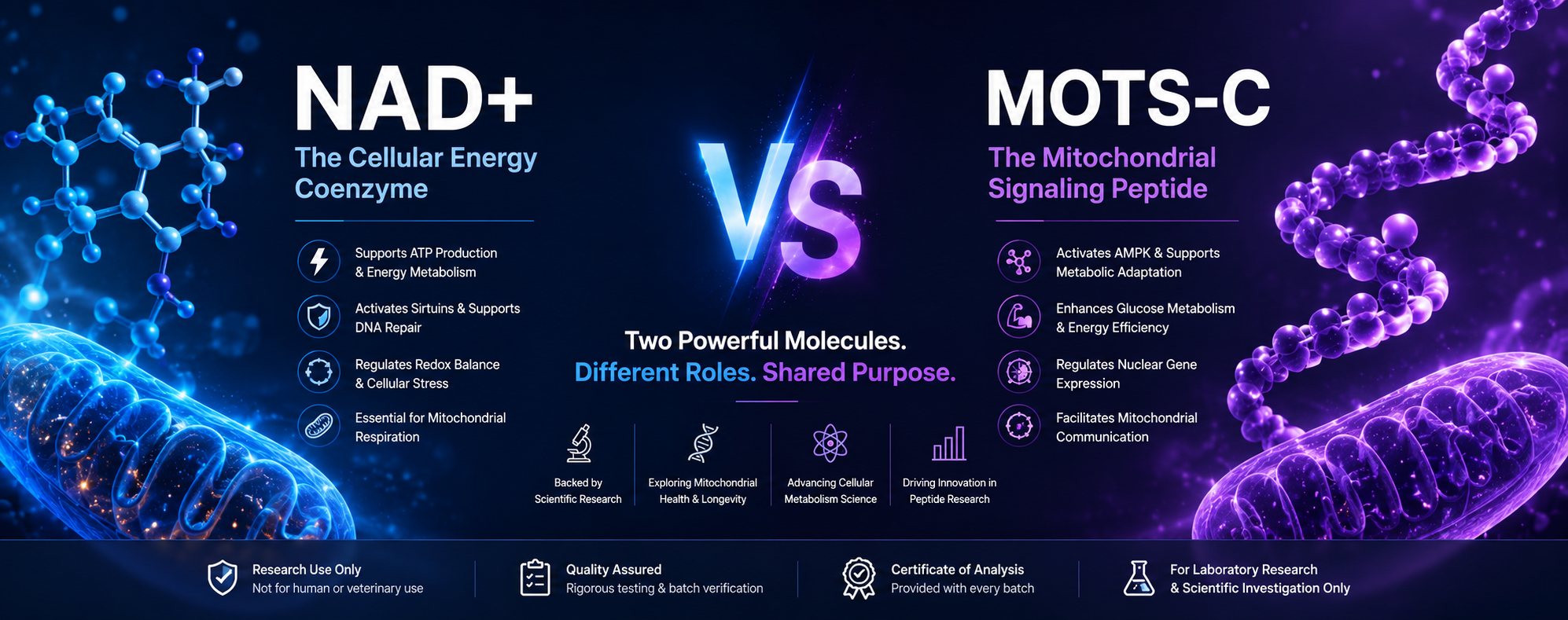
Nicotinamide Adenine Dinucleotide (NAD+) is one of the most important molecules in cellular metabolism. This molecule is found in almost all living cells where it acts as a coenzyme participating in redox reactions and thus helping cells utilize nutrients and produce energy.
In mitochondria, NAD+ accepts and donates electrons, making ATP synthesis via oxidative phosphorylation possible.
NAD+ has been discovered to perform other biological functions such as:
- Energy production by cells
- Mitochondrial respiration
- Processes of DNA repair
- Signalling of cells
- Activation of sirtuins
- Oxidative stress control
The decrease in the levels of NAD+ within the cell has been related to aging and mitochondrial inefficiency.
What Is MOTS-C?
MOTS-C (Mitochondrial Open Reading Frame of the 12S rRNA Type-C) is entirely different.
Rather than acting as a metabolic coenzyme, MOTS-C is a 16-amino-acid mitochondrial peptide encoded directly within mitochondrial DNA.
Its discovery changed the scientific understanding of mitochondria. Previously, mitochondria were viewed mainly as energy-producing organelles. Today, researchers recognise that mitochondria also produce signalling molecules capable of influencing cellular function throughout the body.
MOTS-C has been studied for its potential role in:
- Energy metabolism research
- Metabolic stress adaptation
- AMPK activation
- Glucose metabolism
- Fatty acid utilisation
- Mitochondrial signalling
- Cellular homeostasis
Unlike NAD+, which directly participates in energy production, MOTS-C primarily regulates how cells respond to metabolic stress by influencing gene expression and signalling pathways. Most evidence comes from laboratory and animal studies, while human clinical evidence remains limited.
NAD+ vs MOTS-C: The Fundamental Difference
Although both molecules relate to mitochondria, their biological functions differ considerably.
| Feature | NAD+ | MOTS-C |
|---|---|---|
| Molecule Type | Coenzyme | Mitochondrial peptide |
| Location | Present throughout cells | Encoded by mitochondrial DNA |
| Primary Function | Electron transfer and energy metabolism | Cellular signalling |
| Research Focus | Energy production, redox biology | Metabolic signalling |
| Role in Mitochondria | Supports ATP production | Regulates adaptive responses |
| Scientific Category | Metabolic cofactor | Mitochondrial signalling peptide |
Rather than serving identical purposes, these molecules complement different aspects of mitochondrial biology.
How NAD+ Supports Cellular Energy Research
The main reason why NAD+ is widely studied in scientific research is that it is directly involved in ATP synthesis.
Inside mitochondria, NAD+ plays role in the following processes:
- Glycolysis
- Citric acid cycle
- Electron transport chain
- Oxidative phosphorylation
With low levels of NAD+, cells are not able to turn nutrients into energy.
NAD+ is also attractive for scientific researchers due to its role as the substrate for such enzymatic families as:
- Sirtuins
- PARPs
- CD38 enzymes
Such enzymes control various physiological functions of cells.
How MOTS-C Influences Mitochondrial Signalling
Unlike NAD+, MOTS-C acts mainly as a signal molecule.
From experiments carried out in laboratories, it is believed that MOTS-C might be able to:
- Act as an AMPK activator
- Affect glucose metabolism
- Induce metabolic flexibility
- Control nuclear gene expression
- Aid cell adaptation to metabolic stress
What is particularly fascinating about this research is the ability of MOTS-C to be transferred from the mitochondria to the nucleus under conditions of stress, where it may play a role in controlling genes related to metabolism and stress response.
Why Researchers Compare NAD+ and MOTS-C
Though their processes are different, scientists often make comparisons between these molecules since both affect mitochondrial functions.
NAD+ affects:
- Availability of energy in cells
- Enzymes
- Balance in oxidation-reduction reactions
- Mitochondrial metabolism
MOTS-C affects:
- Signaling in cells
- Adaptation of metabolism
- Responses to stress
- Gene expression
Instead of finding out which of these molecules is “better” laboratory scientists usually try to figure out how each one affects mitochondria differently.
Applications in Mitochondrial Research
Present scientific studies with NAD+ include the following:
- Studies on cellular ageing
- Mitochondrial dysfunction
- Energy metabolism
- Oxidative stress
- DNA repair
- Cellular resiliency
In the case of MOTS-C, studies are ongoing in the following domains:
- Studies on exercise physiology
- Metabolic regulation
- Glucose homeostasis
- Mitochondrial signaling
- Cellular adaptation
- Life span studies
Cellular Metabolism: Different Pathways, Shared Interest
Cellular metabolism depends on hundreds of interconnected biochemical pathways.
NAD+ contributes directly by enabling metabolic reactions.
MOTS-C contributes indirectly by influencing how cells respond to metabolic demands.
An easy analogy is:
- NAD+ supplies the machinery needed for energy production.
- MOTS-C helps determine how the machinery responds to changing conditions.
This difference explains why the two molecules continue to attract attention within cellular energy research.
Current State of Scientific Evidence
The role of NAD+ has been studied for many years, leading to thousands of articles being written on the subject of NAD+’s role in metabolism, aging, mitochondrial function, and pathogenesis of diseases.
In contrast, the discovery of MOTS-C is rather new.
While preclinical results are encouraging, the number of scientific publications available on the topic is significantly lower, with the majority of published material being obtained through:
- In vitro cell cultures
- Animal testing
- Bench research
Little to no human clinical data regarding exogenous MOTS-C is currently available.
Quality Matters in Laboratory Peptide Research
While undertaking peptide research in laboratories, scientists need to have quality peptides at their disposal.
Quality peptides for research use only must be characterized with:
- High purity confirmation
- Batch traceability
- Independent analysis
- Documentation
Research materials from PeptidesX are backed up with:
Certificate of Analysis
Each batch includes a Certificate of Analysis (COA) documenting identity, purity, and analytical results. This allows researchers to verify batch-specific quality before use in laboratory investigations.
Quality & Testing
Research peptides undergo rigorous analytical assessment using methods such as:
- High-Performance Liquid Chromatography (HPLC)
- LC-MS verification
- Identity confirmation
- Purity analysis
These procedures support consistency between research batches.
Packaging Standards
Proper packaging helps maintain product integrity during transport and storage.
Typical packaging standards include:
- Sterile lyophilised presentation
- Tamper-evident containers
- Batch identification
- Protective secondary packaging
- Clearly labelled Research Use Only materials
Storage Guidelines
In order to maintain stability, the following guidelines should be followed by the researchers while storing the materials:
- The unopened lyophilized material should be stored in laboratory conditions.
- The products should be protected from heat, humidity, and exposure to light.
- The process of thawing and freezing should be minimized after reconstitution if needed.
Research Use Only
NAD+ and MOTS-C supplied by PeptidesX are provided strictly as Research Use Only materials.
They are intended exclusively for:
- Laboratory investigation
- Scientific education
- Analytical testing
- Preclinical research
These materials are not approved for human consumption, therapeutic use, veterinary use, or diagnostic applications.
Frequently Asked Questions
Is NAD+ a peptide?
No. NAD+ is a naturally occurring coenzyme involved in cellular metabolism and energy production.
Is MOTS-C a peptide?
Yes. MOTS-C is a mitochondrial-derived peptide consisting of 16 amino acids.
Which is more important for mitochondrial research?
Both are important but serve different scientific purposes. NAD+ functions as a metabolic cofactor, while MOTS-C acts as a mitochondrial signalling molecule.
Why are researchers interested in both molecules?
They influence different aspects of mitochondrial biology, providing complementary insights into cellular metabolism, energy regulation, and stress responses.
Can NAD+ and MOTS-C be considered the same?
No. They differ in structure, biological function, and mechanism of action, despite both being associated with mitochondrial research.
Conclusion
NAD+ and MOTS-C are two separate but related fields of mitochondrial research in the modern world. NAD+ is an important component of cell metabolism, enzymatic reactions, and redox biology, while MOTS-C is a signaling peptide derived from mitochondria.
As science progresses and gains new insights into mitochondria, more research is being conducted on the role of NAD+ and MOTS-C in cellular metabolism in various ways. Although a lot has been researched about NAD+ for many years, MOTS-C is a relatively new area of study with many interesting laboratory results, which still need further research.
For researchers studying mitochondria, cellular energy, and peptides in laboratories, it is very important to know the difference between these molecules.
Disclaimer: This article is for educational purposes only. NAD+ and MOTS-C products sold by PeptidesX are for Research Use Only and are not for human or veterinary use.