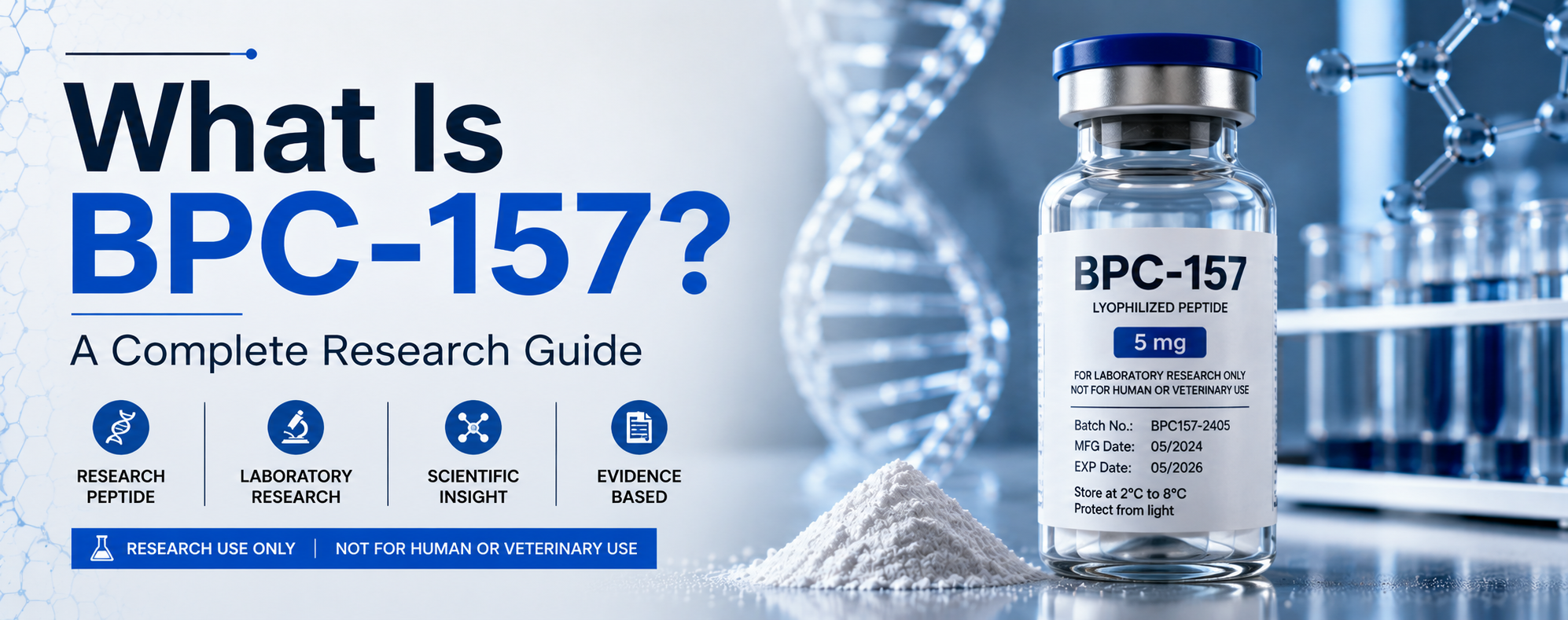
One of the most popular peptides under investigation in contemporary peptide research is BPC-157. In recent decades, this peptide has received a lot of attention from the scientific community due to its high stability and uniqueness in biological effects and applicability in experiments.
Although BPC-157 is often referred to in scientific and internet literature, it is still an investigational peptide, which means that its biological activity is being investigated in laboratory and preclinical experiments.
This article aims to provide information on what BPC-157 is, how it acts in laboratory experiments, the fields of research, and the things that need to be considered when working with research-grade peptide products.
What Is BPC-157?
BPC-157 means Body Protection Compound-157. It is a synthetic peptide that contains 15 amino acids and comes from a fragment of a protein that was found in human gastric juice.
The synthetic version of the compound has been created by scientists to study its biological properties through experiments.
In contrast to other investigational peptides, which usually affect one receptor or a signalling pathway only, BPC-157 has been researched in various biological systems.
Such high level of scientific interest in the peptide has made it one of the most researched investigational peptides in connective tissue and gastrointestinal studies.
Though there are numerous studies on BPC-157, the compound has not received any approval as a drug in the UK yet and is only sold as a RUO product by research peptide companies.
Chemical Characteristics
The following key properties of BPC-157 have been analyzed:
- Synthetic peptide consisting of 15 amino acids
- Extracted from a naturally existing protein in the stomach
- Dissolvable in water post-laboratory dissolution
- Generally available as sterile lyophilized powder
- High stability during proper laboratory storage
These properties allow researchers to study the compound under laboratory conditions.
How Does BPC-157 Work?
Scientists continue to study the effects of BPC-157 on various pathways of biological signaling.
Studies have been conducted in relation to its interaction with:
- Nitric oxide (NO) signaling pathway
- Angiogenesis (formation of new blood vessels)
- Regulation of growth factors
- Migration of cells
- Organization of extracellular matrix
- Connective tissue biology
- Inflammation signaling pathway
- Gastrointestinal physiology
It has been found that BPC-157 might affect several pathways at once; however, more research is required to know the exact mechanism involved.
Due to all the aforementioned interactions, scientists are continuing to study its effects on various biological systems..
Why Is BPC-157 Studied?
The peptide BPC-157 has been extensively used as a topic of study in laboratories since the scientists wish to know how several biological pathways interact in tissue organization and cellular adaptations.
Scientific studies are being conducted for:
- Connective tissue biology
- Tendon and ligament laboratory models
- Fibroblast function
- Angiogenesis study
- Nitric oxide signaling
- Gastrointestinal mucosa biology
- Growth factor signaling
- Signaling pathways
Such diverse scope of applications of the peptide has made it popular among the researchers studying peptides.
Current Research Areas
Laboratory investigations involving BPC-157 include:
Connective Tissue Research
Scientists explore the effect of BPC-157 on experimental models which include tendons, ligaments, muscles, connective tissues and others, so that to study cellular architecture and the extracellular matrix.
Gastrointestinal Biology
As the name suggests, scientists conduct further research of the relationship between BPC-157 and the functioning of the gastrointestinal tract.
Angiogenesis
The effects of the interaction of BPC-157 with signalling pathways of vascular biology and angiogenesis are studied experimentally.
Nitric Oxide Signalling
Studies of interaction of BPC-157 with nitric oxide pathways are conducted since the pathways affect many biological processes.
Cellular Communication
Molecular signaling studies are being conducted to help understand how tissues behave through the controlled conditions of a laboratory setting.
Growth Factor Research
Research still examines the interactions of several growth factor pathways involved in tissue organization.
How Is BPC-157 Manufactured for Research?
BPC-157 of research grade is normally made via synthetic peptide synthesis technology, which is aimed at obtaining consistent quality and purity.
After synthesizing, the product is then purified and made sterile lyophilized powder for storage and dilution.
The quality control process may usually include:
- Product identification
- Purity analysis
- Sterility controls when needed
- Batch identification
- Stability testing
These processes help increase the consistency of production batches in scientific studies.
Why Analytical Testing Matters
Analytical methods for assessing the quality of peptides include identification and purity assessment of peptides.
The most frequently used methods include:
High-Performance Liquid Chromatography (HPLC)
HPLC is used to check purity and also to identify impurities that can interfere with the experiment in the lab.
Mass Spectrometry
The molecular weight and identity of the peptides are determined through mass spectrometry.
Batch Documentation
Researchers often review batch-specific documentation to ensure consistency before beginning laboratory work.
Understanding the Certificate of Analysis (COA)
COA is one of the necessary documents that come along with many research grade peptides.
The typical components of COA include:
- Product identification
- Batch code
- Analytical purity
- HPLC chromatogram
- Mass spectroscopy data
- Date of manufacture
- Testing lab details
Going through a COA assists researchers to verify the identity and analytical parameters of the production batch.
Storage and Handling
Proper storage ensures the maintenance of peptide stability during laboratory investigations.
General guidelines in laboratories involve the following:
- The lyophilized form of the peptide should be stored in accordance with manufacturer’s guidelines.
- Post-laboratory reconstitution, samples may be stored at temperatures ranging from 2°C to 8°C.
- Samples should be protected from high temperature and light exposure.
- Freezing and thawing cycles should be minimized wherever possible.
BPC-157 and Research Use Only (RUO)
BPC-157 of research grade is provided solely for laboratory study purposes.
RUO reagents are used for scientific study, analysis, and experiments. Their application should not be made either for humans or animals; these substances may be applied solely in laboratory conditions.
It is important that researchers choose materials supplied by providers with clear documentation.
What Should Researchers Look For?
Selection criteria when choosing research grade peptides include:
- High level of purity
- Certificate of Analysis for each batch
- HPLC analysis
- Mass spectrometry analysis
- Traceability of batches
- Research Use Only labeling
- Suitable storage conditions documentation
The above criteria enhance the reliability of experiments conducted in laboratories.
Frequently Asked Questions
Is BPC-157 a naturally occurring peptide?
The peptide utilized for research purposes is synthetic in nature, though it is derived from the protein fragment which was initially found in human gastric juice.
Why is BPC-157 widely studied?
BPC-157 is researched due to its involvement in various biological processes related to connective tissue biology, angiogenesis, physiology of gastrointestinal tract, and cellular signaling.
Is BPC-157 approved as a medicine?
BPC-157 continues to be an investigational peptide. Scientists are recommended to inquire about the current status of this peptide from the concerned regulatory bodies in their region.
What form is BPC-157 supplied in?
BPC-157 used in laboratories is normally supplied as lyophilized powder.
Why is a COA important?
Batch-specific Certificate of Analysis assists scientists in establishing the authenticity of the product and the results of its analysis.
Conclusion
The scientific relevance of the peptide BPC-157 will not diminish due to its numerous biological functions and multiple areas of experimental investigation.
Current studies include its relations to connective tissue biology, angiogenesis, nitric oxide signaling, gastrointestinal system functioning and cell communication to reveal the molecular mechanisms behind.
With time, the research will keep on adding new data about this peptide to the pool of scientific information. In terms of research purposes, the quality of products, their analysis and documentation are always relevant.
Research Use Only: The peptide BPC-157 presented in this article is exclusively intended for laboratory and scientific research purposes. Human and veterinary use is not approved.