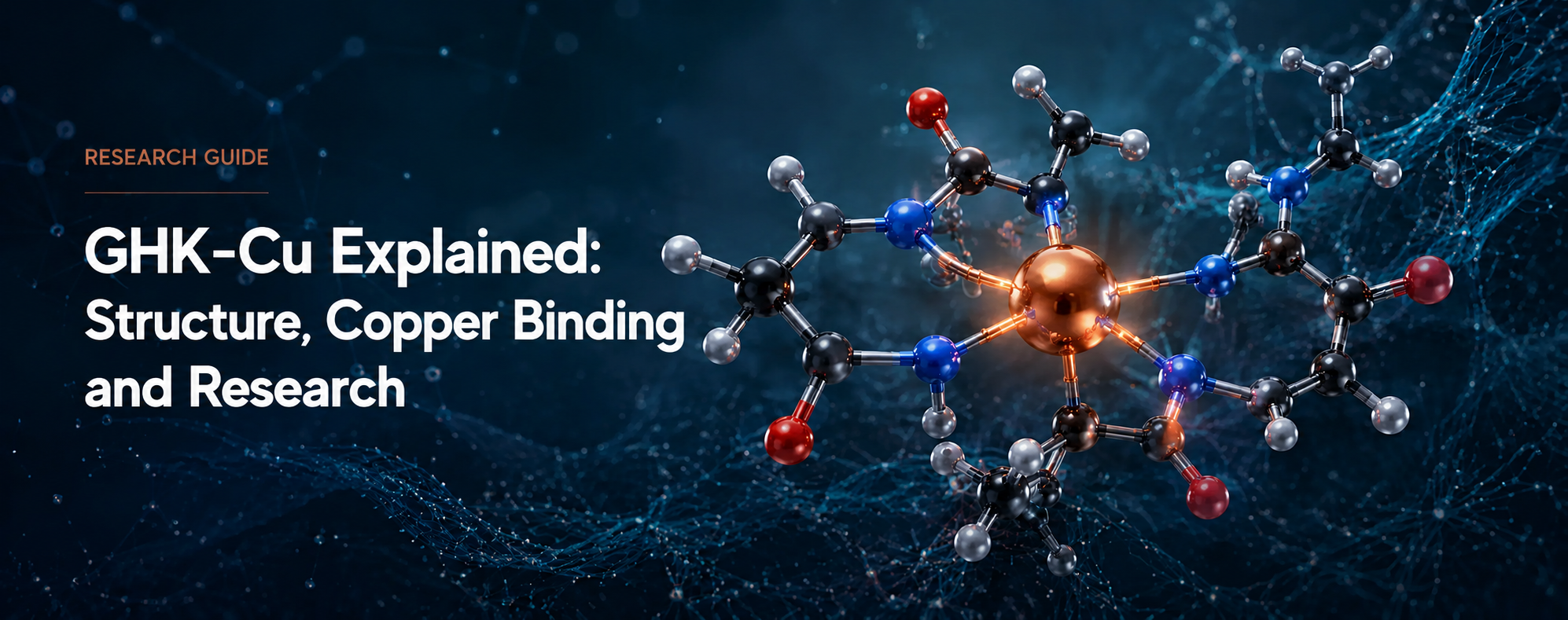
GHK-Cu is a copper-binding molecule that has garnered considerable scientific attention over the past few decades. Studies on this complex have focussed on its chemical properties, biological effects and involvement in extracellular matrix processes. This article provides information about what GHK-Cu is, how it binds copper in its molecular structure and the current scientific understanding of it.
GHK-Cu often appears in relation to collagen, tissue repair and skin science. However, such connections need to be interpreted cautiously. The available information is based mostly on in vitro studies, cell culture research and animal models. Such research enables scientists to formulate theories but does not confirm their clinical usefulness.
What is GHK-Cu?
GHK-Cu is the term given to the complex formed when the tripeptide GHK binds a copper ion. GHK is an abbreviation for glycyl-L-histidyl-L-lysine, denoting the three amino acids: glycine, histidine, and lysine. Copper-bound complexes are generally known as copper peptides or copper tripeptides. GHK was first isolated during the investigation of factors present in human plasma. Further investigations showed the presence of this peptide in human plasma, saliva, and urine. The natural occurrence of this peptide made GHK a topic of biochemical research and not just another designed peptide. The free peptide is referred to as GHK, while the complex of GHK with copper is called GHK-Cu or GHK-Cu(II). The reason is that the nature of the coordination of the molecule changes on binding copper. Some biological effects of experiments also show difference with respect to copper bound GHK and free GHK. Readers unfamiliar with peptide terminology can first review What Are Peptides?. That guide explains amino acids, peptide bonds and the differences between short peptides and larger proteins. GHK is particularly compact because it contains only three amino-acid residues.Understanding the structure of GHK
GHK follows the amino-acid sequence glycine-histidine-lysine. Glycine is positioned at the N-terminus, histidine occupies the centre and lysine forms the C-terminal residue. Peptide bonds connect these amino acids, creating a small molecule with several potential metal-coordination sites. Histidine is particularly important because its imidazole side chain can participate in metal binding. The terminal amino group and peptide nitrogen also contribute to copper coordination. Their spatial arrangement enables GHK to form a relatively stable complex with divalent copper, normally represented as Cu²⁺. Lysine contributes a positively charged side chain under many experimental conditions. Although not every part of the molecule coordinates copper directly, the complete sequence influences the complex’s shape, charge and interactions. Changing an amino acid could therefore alter both its binding behaviour and biological activity. GHK has a molecular formula of C₁₄H₂₄N₆O₄. Once complexed with copper, its composition and electronic properties change. Researchers studying GHK-Cu must consequently distinguish peptide identity from metal occupancy, since a sample containing GHK does not necessarily consist entirely of the copper-bound form.How does GHK bind copper?
Copper complexation entails the formation of coordination bonds between the copper (II) ion and electron donor atoms in GHK. Structural studies show that nitrogen atoms are involved in coordination bonding with the copper (II) ion. These chelate binds copper more tightly than would occur in a simple mixture of compounds. Chelation is a process where a compound forms bonds with a metal ion at multiple coordination points. GHK is considered a copper chelator due to the involvement of multiple binding points in forming a coordination bond. Investigators cannot consider GHK-Cu to be equivalent in all protocols for experiments. Investigators cannot consider GHK-Cu to be equivalent in all protocols for experiments. Albumin and other proteins also bind copper in biological environments. GHK-Cu must therefore be considered within a broader network of metal-binding compounds. Early research proposed that GHK might participate in copper transport or exchange, although its precise physiological contribution remains incompletely defined. Copper is an essential trace element and a cofactor for several enzymes. It can also participate in redox chemistry when poorly controlled. Binding by peptides and proteins helps regulate its chemical environment. This makes GHK-Cu interesting to researchers examining metal homeostasis, oxidative processes and cellular signalling.Why does copper matter in biological research?
Copper supports enzymes involved in energy metabolism, antioxidant defence, connective-tissue formation and pigment production. Lysyl oxidase, for example, is copper-dependent and contributes to collagen and elastin cross-linking. These established copper functions provide useful context but do not prove that GHK-Cu produces a particular outcome. The biological behaviour of a copper complex cannot be inferred solely from the properties of copper itself. Free copper ions, protein-bound copper and peptide-bound copper may differ in availability and reactivity. Well-designed experiments should therefore include suitable controls for GHK, copper and GHK-Cu. Concentration also matters. Trace metals may support normal biochemical processes within one range but disturb cells at higher exposures. Studies should document the tested concentration, exposure period, culture conditions and control groups. Results obtained under one model should not be generalised beyond that system without supporting evidence.GHK-Cu and extracellular matrix research
The extracellular matrix is the organised network surrounding cells. It contains collagen, elastin, glycoproteins, proteoglycans and other structural components. Rather than serving as passive scaffolding, this matrix influences cell adhesion, migration, mechanical signalling and the organisation of tissues. The effects of GHK-Cu on fibroblasts – which are the cells that produce matrix constituents – have been explored in laboratory tests. Some studies have documented changes in collagen, glycosaminoglycans and proteoglycans. Such results explain the scientific interest in GHK-Cu, but the experimental approaches and quality of evidence have varied. In addition, GHK-Cu has been researched in association with matrix metalloproteinases, which are often called MMPs. They play an important role in the degradation and remodeling of matrix proteins. In one study conducted using fibroblast cultures, higher MMP-2 expression was noted. This balance is important. Tissue remodelling does not simply mean producing more collagen. Functional remodelling requires coordinated synthesis, organisation and degradation. Claims that describe GHK-Cu only as a “collagen booster” overlook this complexity and can misrepresent what laboratory findings actually demonstrate. A more detailed examination is available in GHK-Cu and Collagen: What Does the Research Show?. That article focuses specifically on collagen-related findings, whereas this foundation guide covers the peptide’s structure, copper coordination and broader experimental context.Cell signalling and gene-expression studies
GHK and GHK-Cu have been studied in relation to gene expression databases and pathway maps in cells. Review articles that have been published suggest that these compounds might be involved in regulating genes related to repair, inflammation, and the extracellular matrix. Such analyses may help generate research ideas but do not constitute clinical evidence. Altered gene expression does not necessarily reflect changes in protein production, tissue organisation, and even whole-body physiology. It is necessary for scientists to validate the gene expression data using targeted experimental approaches. This is particularly important when where a compound affects several pathways at once. Antioxidant and anti-inflammatory findings should also be interpreted carefully because the terms represent diverse types of assays and biological phenomena. Alteration of a specific oxidative stress marker does not mean there is a general protective effect. Interpretation depends on the model, comparison and endpoint used.Wound and tissue-remodelling models
GHK-Cu has been investigated in cell cultures and animal models involving tissue repair. Reported observations include changes in fibroblast activity, matrix components, blood-vessel formation and wound closure. These studies helped shape current research interest, but animal findings cannot be assumed to predict outcomes in humans. Differences in species, wound design, delivery method and measurement timing can produce substantially different results. Some literature also consists of narrative reviews drawing together older experiments. Readers should examine the underlying study design instead of relying only on broad conclusions reported in secondary sources. Human evidence is more limited and is often discussed in the context of topical cosmetic formulations rather than research compounds supplied in laboratory vials. Cosmetic ingredients, medicines and research materials are separate product categories. Evidence from one formulation should not be transferred automatically to another.Interpreting the evidence responsibly
The literature on GHK-Cu includes biochemical studies, cell-culture experiments, animal models, reviews and some small human investigations. This variety is useful, but it also creates uneven evidence. Findings should be grouped by study type before conclusions are drawn about mechanisms, reproducibility or biological significance. Researchers should check whether a paper tested free GHK, copper chloride, GHK-Cu or a modified derivative. These materials are related but not interchangeable. Details including purity, metal-to-peptide ratio and analytical confirmation can influence the reliability and reproducibility of an experiment. Positive findings may also receive more attention than neutral results. Small studies, limited replication and variation in laboratory protocols introduce uncertainty. Strong conclusions require converging evidence from independent research groups using validated materials, appropriate controls and clearly reported statistical methods.Quality considerations for laboratory GHK-Cu
Peptide purity is commonly evaluated using high-performance liquid chromatography, while mass spectrometry can help confirm molecular identity. Neither result alone describes every quality characteristic. Researchers should review the batch documentation, analytical methods, expected molecular form and any stated limitations before beginning experimental work. For GHK-Cu, confirming peptide identity does not necessarily establish copper content or complete complex formation. Depending on the project, researchers may require additional elemental or spectroscopic analysis. The appropriate tests depend on whether the study concerns peptide purity, metal coordination, concentration or biological response. The GHK-Cu research product page provides product-specific information and available batch documentation. The material is supplied strictly for laboratory and scientific research purposes. It is not intended for human consumption, medical treatment, veterinary use or self-experimentation. Storage and handling should follow the supplier’s documented instructions and the laboratory’s validated procedures. Exposure to moisture, inappropriate temperatures or unsuitable solutions may affect sample integrity. Researchers should record preparation dates, storage conditions, freeze-thaw events and relevant observations throughout the study.What remains unknown?
Although considerable research has been conducted, the exact physiological function of GHK-Cu has not been determined. The chemical interaction between GHK and copper is well understood, but how GHK-Cu acts as a transporter for copper in various biological environments is yet to be fully defined scientifically. Many theories have been developed from correlations made in various experimental settings, but there are still unanswered questions regarding dose–response relationships, the specificity of its sites of action, stability in biological solutions, and contributions of GHK and copper individually. There is also a need for better standardisation. Research reports do not always use identical GHK-Cu preparations, analytical confirmation or endpoint definitions. Greater transparency around materials and methods would make comparisons easier and help distinguish reproducible effects from observations limited to particular experimental conditions.Frequently asked questions
Is GHK-Cu a protein?
No, GHK-Cu is a complex of copper and a tripeptide, meaning that the peptide chain in this complex consists of three amino acids only. Proteins are longer chains, which form complex spatial structures.Are GHK and GHK-Cu the same material?
No, not quite. GHK is the name for the free tripeptide glycyl-L-histidyl-L-lysine. GHK-Cu, on the other hand, is the name for the molecule where GHK forms a coordination compound with a copper atom. It is important to know which one was studied.Why is GHK-Cu linked with collagen research?
Several cell and tissue studies have examined changes in fibroblast behaviour, collagen-related processes and extracellular matrix remodelling. These findings create a research rationale, but they do not support unrestricted health claims. Results must be interpreted according to the model and experimental design used.Is research-grade GHK-Cu intended for personal use?
No. Research-grade GHK-Cu supplied by PeptidesX is intended only for controlled laboratory and scientific work. It is not a medicine, food supplement or cosmetic product and must not be consumed, injected, applied to people or used for veterinary purposes.Conclusion
GHK-Cu is an intriguing little complex that arises from the combination of glycine, histidine, lysine, and copper. Coordination chemistry studies link peptide research with investigations concerning metal transport, modulation of extracellular matrix function, and cellular response processes. These connections help explain why it remains so appealing as a subject of investigation in the laboratory. The current evidence indicates is that GHK-Cu has provided interesting findings in laboratory, biochemical and preclinical models, although there are still important questions left to be answered about its mechanisms of action and translation. Proper material characterisation, appropriate controls and accurate reporting of data are absolutely crucial.
⚠️
This content is provided for educational and scientific research purposes only. GHK-Cu is not intended for human consumption, medical treatment, veterinary use or self-experimentation. The information presented does not constitute medical advice or confirm clinical safety or effectiveness.