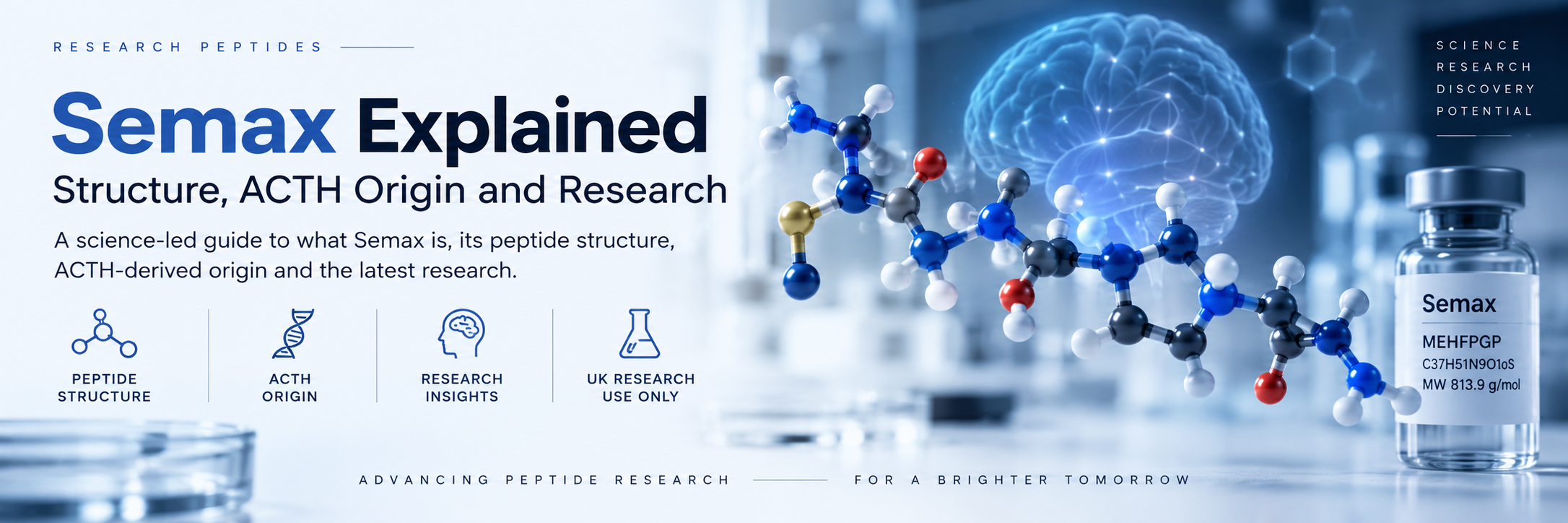
Semax is a synthetic peptide that has attracted scientific interest because of its relationship to adrenocorticotropic hormone (ACTH) and its reported activity in experimental models involving neurotrophic signalling, gene expression and neuronal function.
For researchers asking what is Semax, the most useful starting point is its molecular structure. Semax is a short peptide consisting of seven amino acids. Its sequence is Met-Glu-His-Phe-Pro-Gly-Pro, commonly abbreviated as MEHFPGP. The first four amino acids correspond to residues 4–7 of ACTH, while the final Pro-Gly-Pro sequence forms an additional tripeptide segment.
This structural relationship explains why scientific papers frequently describe Semax as an ACTH(4–10) analogue, even though its exact sequence is not identical to the natural ACTH(4–10) fragment.
Semax remains primarily a research compound in the UK context. Research into the peptide includes biochemical, cellular and animal investigations, while much of the historical clinical literature originates from Russia. Findings from these studies should therefore be interpreted according to their experimental design and should not be treated as evidence of an approved therapeutic application.
What Is Semax?
Semax is a synthetic heptapeptide, meaning that it contains seven amino-acid residues linked by peptide bonds.
Its sequence is:
Met–Glu–His–Phe–Pro–Gly–Pro
Or, using single-letter amino-acid notation:
MEHFPGP
PubChem lists Semax as ACTH(4–7), Pro-Gly-Pro, with the molecular formula C37H51N9O10S and a molecular weight of approximately 813.9 g/mol.
The seven residues are:
- Methionine (Met)
- Glutamic acid (Glu)
- Histidine (His)
- Phenylalanine (Phe)
- Proline (Pro)
- Glycine (Gly)
- Proline (Pro)
Understanding this sequence is important because Semax was developed from research into shorter fragments of ACTH rather than as an unrelated peptide.
Researchers interested in peptide identity and analytical verification should distinguish structural identity from purity alone. Analytical techniques may be used to investigate whether a sample corresponds to its expected molecular characteristics. Our Certificate of Analysis information explains how analytical documentation fits into research-material verification.
The ACTH Origin of Semax
ACTH, or adrenocorticotropic hormone, is a naturally occurring peptide hormone consisting of 39 amino acids. It forms part of the hypothalamic-pituitary-adrenal axis and is best known for its role in stimulating adrenal corticosteroid production.
However, researchers have also investigated shorter fragments of the ACTH molecule.
Semax emerged from this area of peptide research. Its N-terminal sequence — Met-Glu-His-Phe — corresponds to amino-acid residues 4–7 of ACTH.
Natural ACTH(4–10) has the sequence:
Met-Glu-His-Phe-Arg-Trp-Gly
Semax instead has the sequence:
Met-Glu-His-Phe-Pro-Gly-Pro
The distinction matters. Calling Semax an ACTH(4–10) analogue describes its scientific lineage; it does not mean that Semax and ACTH(4–10) are chemically identical.
A more structurally precise description is ACTH(4–7)-Pro-Gly-Pro, sometimes shortened to ACTH(4–7)-PGP.
This terminology makes the molecular design particularly clear: the first four residues originate from the ACTH sequence, followed by a Pro-Gly-Pro tripeptide.
Why Was the Pro-Gly-Pro Sequence Added?
One important feature distinguishing Semax from the corresponding natural ACTH sequence is its Pro-Gly-Pro (PGP) region.
Short peptides can be susceptible to enzymatic degradation. Their amino-acid sequences can be cleaved by peptidases, potentially limiting how long an intact sequence remains available in an experimental system.
The PGP component has consequently attracted attention in studies examining the biological and physicochemical characteristics of Semax and related peptides.
This also highlights an important principle of peptide research: changing only a few amino acids can substantially alter molecular behaviour.
Replacing part of a naturally occurring sequence may affect properties such as conformational flexibility, enzymatic stability, receptor interactions or interactions with other biological molecules. Consequently, results obtained with ACTH itself cannot simply be transferred to Semax.
Each molecule requires independent experimental investigation.
Is Semax the Same as ACTH?
No. Semax is derived conceptually and structurally from an ACTH fragment, but it is not ACTH.
Full-length human ACTH contains 39 amino acids, whereas Semax contains seven.
This difference is particularly important when interpreting research involving endocrine activity. The classical physiological role of ACTH is associated with activation of melanocortin 2 receptors in the adrenal cortex and subsequent corticosteroid production.
Semax was developed from a much smaller section of the ACTH molecule and has been investigated primarily for biological effects outside this classical endocrine function.
Researchers should therefore avoid assuming that an ACTH-derived peptide automatically reproduces the hormonal activity of intact ACTH.
The relationship is better understood as one of molecular ancestry rather than functional equivalence.
What Does Semax Research Investigate?
Published Semax research covers several experimental areas, although the strength and maturity of evidence differ considerably between them.
One of the most frequently investigated areas is neurotrophic signalling.
Neurotrophins are proteins involved in neuronal development, survival, plasticity and signalling. Two commonly studied examples are brain-derived neurotrophic factor (BDNF) and nerve growth factor (NGF).
A study published in Journal of Molecular Neuroscience investigated neurotrophin gene expression in rat brain following experimental exposure to Semax. Researchers reported changes in BDNF and NGF gene expression in the hippocampus.
Earlier laboratory work also examined the rapid induction of neurotrophin messenger RNA in rat glial cell cultures.
These experiments helped establish neurotrophin regulation as one of the recurring mechanistic themes in Semax research.
However, gene-expression changes in experimental models do not demonstrate that the same response will occur in humans or establish a therapeutic benefit.
Semax and Gene-Expression Research
Semax has also been studied using molecular approaches that examine changes across multiple genes.
This research is particularly interesting because peptides do not necessarily need to act through a single isolated biochemical pathway. Experimental exposure can be associated with downstream changes affecting networks of genes, signalling proteins and cellular responses.
Investigators have explored transcriptional changes associated with Semax in experimental models of cerebral ischaemia and other neurological conditions.
Reported areas of investigation include genes connected with:
- neurotrophic signalling;
- inflammatory processes;
- vascular function;
- immune responses;
- neurotransmitter systems;
- cellular stress responses.
These observations provide hypotheses for further investigation rather than proof of a clinical mechanism.
Transcriptomic findings can identify pathways that respond under particular experimental conditions, but researchers must subsequently determine whether those changes are reproducible, biologically significant and relevant beyond the model in which they were observed.
Research Into Metal-Ion Interactions
Semax research is not limited to neuronal gene expression.
A 2015 study published in the Journal of Inorganic Biochemistry, for example, investigated interactions between Semax and copper(II) ions.
Researchers characterised the peptide’s copper-binding behaviour and examined copper-associated cellular toxicity in experimental cell models.
Later work has also explored interactions between Semax, copper ions and amyloid-beta aggregation in artificial membrane systems.
These experiments illustrate how peptide research can extend beyond receptor pharmacology. A peptide’s amino-acid sequence determines chemical properties that may influence interactions with metal ions, membranes, enzymes and other proteins.
Such studies remain mechanistic and experimental. They should not be interpreted as demonstrating prevention or treatment of neurodegenerative disease.
Semax in Cellular and Animal Models
A substantial proportion of Semax literature consists of preclinical research.
Depending on the scientific question, investigators have used cultured cells, isolated biological systems and animal models to examine molecular responses associated with the peptide.
Animal experiments are particularly useful for investigating processes that cannot easily be reproduced in a simple cell culture. Researchers can examine gene expression across different brain regions, biochemical markers and changes occurring following experimentally induced physiological stress.
However, preclinical models also have clear limitations.
An effect observed in rodents does not establish that an equivalent effect occurs in humans. Differences in physiology, metabolism, experimental conditions and study design can all affect translation.
For this reason, a responsible review of Semax should clearly separate preclinical observations from established human evidence.
How Strong Is the Semax Evidence Base?
The evidence base surrounding Semax is unusual compared with many compounds studied extensively in Western clinical research.
A significant proportion of the historical literature originates from Russian research institutions, and Semax has been investigated there for several decades. Some human studies have been published, particularly within Russian-language neurological literature.
At the same time, independent replication across large, modern, internationally conducted clinical trials remains limited.
This creates an important distinction between quantity of published research and certainty of evidence.
A compound may have numerous laboratory studies without having a sufficiently robust clinical evidence base to establish safety or efficacy for a particular medical purpose.
For UK readers, this distinction is particularly important. Semax should not be presented as though experimental findings establish an authorised medical application in the UK.
Why Analytical Verification Matters in Peptide Research
Reliable peptide research depends not only on experimental methodology but also on the identity and quality of the material being studied.
If the composition of a research sample is uncertain, downstream experimental findings become more difficult to interpret.
Researchers may therefore consider several analytical characteristics, including:
- expected molecular identity;
- peptide sequence;
- chromatographic purity;
- molecular mass;
- batch identification;
- storage and handling information;
- analytical documentation.
Techniques such as high-performance liquid chromatography (HPLC) and mass spectrometry can provide different forms of analytical information.
HPLC can help characterise the chromatographic composition of a sample, while mass-spectrometric methods can provide information relevant to molecular identity.
A percentage purity result alone should not automatically be interpreted as proof of identity. Ideally, analytical evidence is considered together rather than relying on a single number.
You can learn more about these principles through the PeptidesX Certificate of Analysis information.
Semax as a Research Peptide in the UK
Within a UK research context, Semax should be approached as a laboratory research material rather than a consumer therapeutic product.
This distinction should shape both how the peptide is discussed and how experimental evidence is interpreted.
Claims about treating disease, enhancing cognition or producing particular outcomes in people should not be extrapolated from cellular or animal experiments.
Instead, scientifically appropriate discussion can focus on measurable research questions such as molecular structure, peptide stability, biochemical interactions, gene expression and experimental signalling pathways.
Researchers exploring related compounds can browse the broader PeptidesX research peptide shop, while additional educational material covering peptide science and laboratory topics is available through the PeptidesX research blog.
What Is Semax? The Key Points
Semax is a synthetic seven-amino-acid peptide with the sequence Met-Glu-His-Phe-Pro-Gly-Pro (MEHFPGP).
Its first four residues correspond to ACTH(4–7), while the final three form a Pro-Gly-Pro sequence. This structural relationship explains why Semax is commonly described in scientific literature as an analogue of ACTH(4–10).
Research has examined Semax in areas including neurotrophin expression, cellular signalling, transcriptional responses, metal-ion interactions and experimental neurological models.
Much of this evidence remains preclinical, and the existence of experimental findings should not be interpreted as proof of clinical effectiveness or an authorised medical use.
For researchers, Semax is therefore most appropriately understood through its structure, ACTH-derived origin and experimentally investigated molecular properties.
Further information about research peptides and analytical quality principles can be found at PeptidesX UK.
Research-Use Disclaimer: This article is provided for scientific and educational purposes only. Semax is discussed as a research compound and is not presented as a medicine, treatment or recommendation for human use.
Scientific References
- PubChem – ACTH (4–7), Pro-Gly-Pro- (Semax). National Center for Biotechnology Information. Molecular formula, sequence, molecular weight and chemical identifiers.pubchem.ncbi.nlm.nih.gov ↗
- Dolotov OV et al. – Neurotrophin gene expression in rat brain under the action of Semax, an analogue of ACTH 4–10. Journal of Molecular Neuroscience. 2007.pubmed.ncbi.nlm.nih.gov ↗
- Tabbì G et al. – Semax, an ACTH4–10 peptide analog with high affinity for copper(II) ion and protective ability against metal induced cell toxicity. Journal of Inorganic Biochemistry. 2015;142:39–46.pubmed.ncbi.nlm.nih.gov ↗
- Semax, a Synthetic Regulatory Peptide, Affects Copper-Induced Aβ Aggregation and Amyloid Formation in Artificial Membrane Models. Peer-reviewed experimental research available through PubMed Central.pmc.ncbi.nlm.nih.gov ↗