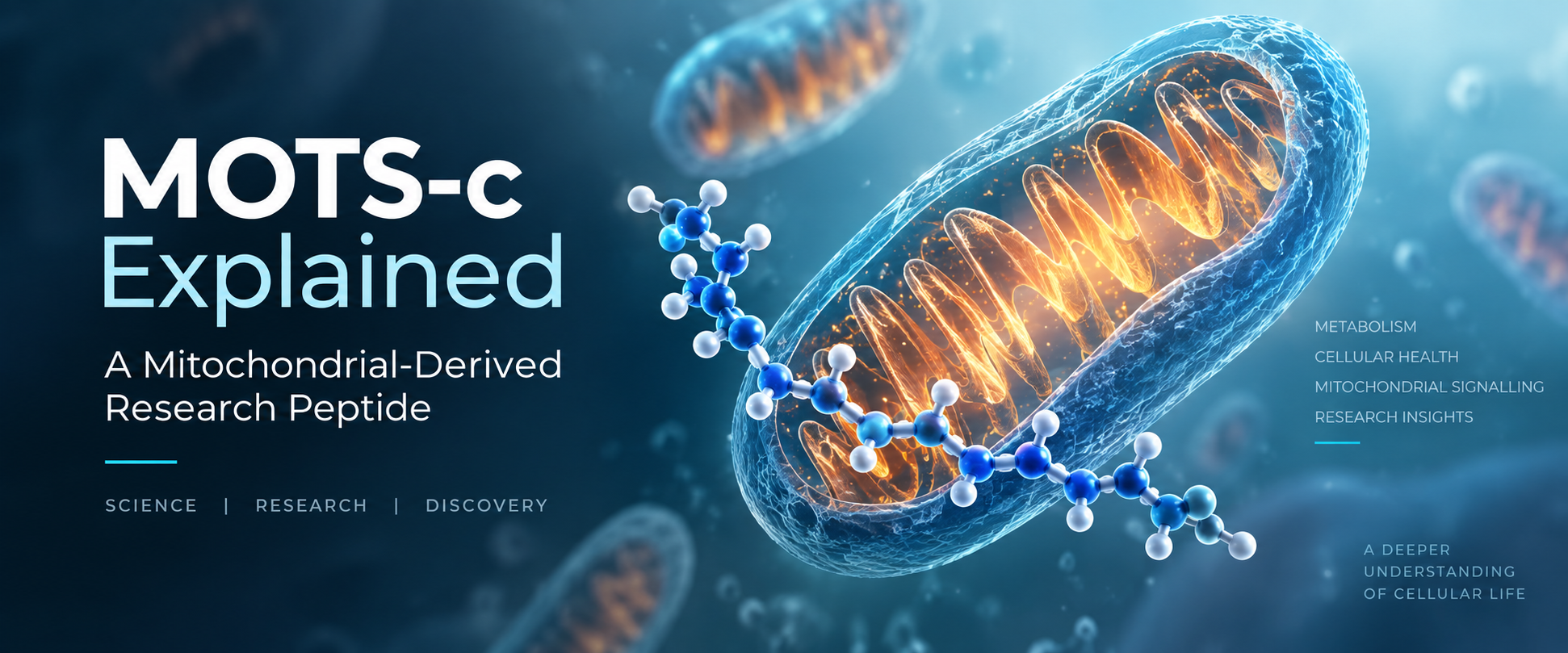
Mitochondria are usually described as the energy-producing structures of cells, but research increasingly suggests that their biological role extends beyond generating ATP. Mitochondria can participate in signalling pathways that influence cellular metabolism, stress responses and communication with the nucleus. One area attracting particular scientific interest is a group of molecules known as mitochondrial-derived peptides (MDPs).
Among these molecules is MOTS-c, a short peptide encoded within mitochondrial DNA. Since its initial characterisation, researchers have investigated its relationship with metabolic regulation, cellular stress, skeletal muscle biology and mitochondrial-to-nuclear signalling.
Thus, what is MOTS-c, and why has it become an interesting molecule in mitochondrial research? This article examines its biological origin, proposed mechanisms and current evidence while distinguishing experimental findings from established human effects.
What Is MOTS-c?
MOTS-c stands for the mitochondrial open reading frame of the 12S rRNA type-c. It is a mitochondrial-derived peptide consisting of 16 amino acids.
Unlike most peptides and proteins studied in human biology, whose genetic instructions originate primarily from nuclear DNA, MOTS-c is encoded by a short open reading frame within the mitochondrial 12S ribosomal RNA region, commonly associated with the MT-RNR1 gene.
This mitochondrial origin is one reason MOTS-c has attracted considerable research attention. Mitochondrial DNA was traditionally understood to encode 13 proteins involved in oxidative phosphorylation, alongside ribosomal and transfer RNAs. The identification of biologically active peptides encoded within short mitochondrial open reading frames expanded the scientific understanding of what the mitochondrial genome may produce.
MOTS-c belongs to the larger family of mitochondrial-derived peptides, including humanin and small humanin-like peptides.
Why Are Mitochondrial-Derived Peptides Important?
Mitochondria are constantly responding to changes in nutrient availability, oxidative conditions and cellular energy requirements. Mitochondria must communicate with the rest of the cell to coordinate these responses.
One important concept in this field is mitochondrial retrograde signalling. This describes signals originating from mitochondria that can influence nuclear gene expression and broader cellular behaviour.
Mitochondrial-derived peptides are being investigated as possible components of this communication network. Research on MDPs suggests that they can be seen not just as structures responsible for energy production but also as producers of signalling molecules that may aid in cellular adaptation.
What’s particularly interesting about MOTS-c is that experiments show it might be able to respond to metabolic stress and interact with energy-regulating pathways.
MOTS-c and Mitochondrial Function
The relationship between MOTS-c and mitochondrial function is more complex than simply increasing mitochondrial energy production.
MOTS-c may function as a metabolic signal, research suggests. Laboratory studies conducted earlier have associated MOTS-c activity with pathways that participate in glucose utilisation, cellular energy sensing and metabolic homeostasis.
One of the most frequently studied pathways associated with MOTS-c is AMP-activated protein kinase, or AMPK.
AMPK functions as an important cellular energy sensor. When cellular energy availability falls, AMPK can help coordinate processes that conserve or generate energy while reducing energy-intensive activities.
There is some experimental evidence that MOTS-c can indirectly affect AMPK activity via changes in cellular metabolism. The peptide has become a particular target for researchers trying to understand how cells respond to metabolic stress because of this link.
The Folate-Methionine Cycle and AMPK
The original research describing MOTS-c identified changes involving the folate-methionine cycle and de novo purine biosynthesis.
Laboratory experiments suggested MOTS-c affected a number of metabolites involved in these pathways. Interestingly, we saw an increase in the intracellular AICAR, or 5-aminoimidazole-4-carboxamide ribonucleotide.
AICAR is associated with activation of AMPK. This provided researchers with a potential biochemical link between MOTS-c and cellular energy-sensing mechanisms.
The proposed sequence is therefore more detailed than saying that MOTS-c simply “activates metabolism”. Experimental findings suggest interactions involving metabolic intermediates, purine synthesis and AMPK signalling.
These mechanisms remain active areas of research, and results obtained from cultured cells or animal models should not automatically be interpreted as demonstrating equivalent effects in humans.
MOTS-c and Nuclear Signalling
Another unusual feature identified in MOTS-c research is its potential ability to participate in communication between mitochondria and the nucleus.
Under certain forms of metabolic stress, experimental studies have reported that MOTS-c can translocate to the nucleus. Once there, it has been associated with the regulation of nuclear gene expression involved in stress adaptation.
This is scientifically significant because mitochondrial DNA and nuclear DNA must work together to maintain normal cellular function.
The behaviour of MOTS-c provides a potential example of a mitochondrial-encoded molecule influencing nuclear activity. Researchers are therefore studying the peptide not only as a metabolic molecule but also as part of a broader mitochondrial signalling system.
This area may help scientists better understand how cells coordinate responses when their metabolic environment changes.
MOTS-c and Glucose Metabolism Research
Metabolic regulation has been one of the most extensively investigated areas of MOTS-c research.
Early experiments using cultured cells and mouse models reported changes in glucose utilisation and metabolic pathways following exposure to MOTS-c. Research has also examined its relationship with skeletal muscle, an important tissue for whole-body glucose metabolism.
In animal studies, investigators have reported associations involving glucose uptake, insulin sensitivity and resistance to certain metabolic stresses. These findings have contributed to interest in MOTS-c within experimental metabolic research.
However, the distinction between experimental models and clinical evidence is essential.
Findings from cells and rodents do not establish that MOTS-c can prevent or treat metabolic disease in humans. Controlled human evidence remains considerably more limited than the preclinical research base.
MOTS-c and Skeletal Muscle Research
Skeletal muscle has become another important focus of MOTS-c investigation.
Researchers have detected MOTS-c in skeletal muscle and circulation, leading to questions about whether the peptide participates in metabolic adaptation within muscle tissue.
A study published in Nature Communications investigated MOTS-c in relation to physical activity, muscle homeostasis and age-dependent physical decline. The researchers reported that exercise increased endogenous MOTS-c expression in human participants, while additional experiments examined the peptide’s effects in cultured cells and mice.
In the animal portion of the study, MOTS-c treatment correlated with changes in physical performance, skeletal muscle metabolism and metabolic stress adaptation.
These findings are valuable for understanding potential biological mechanisms. They should not, however, be interpreted as evidence supporting MOTS-c use for improving human athletic performance.
What Does Human Research Show?
Research on humans with MOTS-c has been conducted but is still far less developed than research on animals in the laboratory.
Studies have investigated naturally occurring MOTS-c concentrations in blood and skeletal muscle. Researchers have also examined whether endogenous MOTS-c changes in response to exercise.
One study in healthy volunteers showed increased endogenous MOTS-c levels in skeletal muscle and circulation following exercise. A further study of mitochondrial-derived peptides revealed that endurance exercise affected circulating MDP levels, but the results for MOTS-c were less conclusive than those for humanin.
These studies concern naturally occurring MOTS-c and biological responses to exercise. They are not equivalent to clinical trials demonstrating the safety or effectiveness of externally administered MOTS-c.
This distinction is particularly important when interpreting claims about the peptide online.
MOTS-c and Ageing Research
Ageing is accompanied by changes in mitochondrial function, cellular energy regulation and the ability to respond to physiological stress. These processes have led researchers to investigate mitochondrial-derived peptides in ageing models.
Several studies and reviews have examined associations between MOTS-c and age-related biological changes. Some research suggests that circulating or tissue concentrations may vary with age, while animal studies have explored their relationship with physical capacity and metabolic homeostasis in older organisms.
The underlying scientific question is whether mitochondrial signalling molecules contribute to the cellular adaptations that change during ageing.
At present, MOTS-c should therefore be regarded as an experimental tool for investigating these biological pathways rather than an established anti-ageing intervention.
What Are Researchers Currently Studying?
MOTS-c research spans several interconnected areas of cellular and molecular biology.
Current scientific interest includes mitochondrial-to-nuclear communication, AMPK signalling, metabolic stress responses, glucose metabolism, skeletal muscle biology, exercise physiology and age-associated changes in mitochondrial regulation.
Researchers are also investigating how mitochondrial-derived peptides fit into the wider signalling network that connects mitochondrial activity to cellular homeostasis.
As the field develops, improved analytical methods and controlled human studies may help determine which findings from preclinical experiments translate into human physiology.
For laboratory researchers, MOTS-c research peptide material can provide a controlled means of investigating these molecular mechanisms in appropriate experimental systems.
Important Limitations of MOTS-c Research
Despite increasing scientific interest, several limitations should be considered when reviewing the MOTS-c literature.
Much of the mechanistic evidence comes from cultured cells and animal models. These experimental systems are useful for identifying biological pathways, but they cannot fully reproduce human physiology.
Human studies remain relatively limited and frequently examine endogenous MOTS-c concentrations rather than administering the peptide as an intervention.
Differences in experimental models, detection methods, concentrations and research protocols can also make direct comparisons between studies difficult.
Claims that MOTS-c has established effects on weight loss, longevity, athletic performance or particular diseases therefore extend beyond what the current human evidence can reliably demonstrate.
MOTS-c as a Research-Use-Only Peptide in the UK
Within the UK research context, MOTS-c should be approached as an experimental research material rather than a therapeutic product.
Research peptides supplied for laboratory purposes are intended for controlled scientific investigation. They should not be represented as licensed medicines or products intended to diagnose, prevent or treat disease.
When designing experiments, researchers sourcing peptides should consider factors such as batch identification, analytical documentation, storage conditions and appropriate laboratory handling procedures.
PeptidesX supplies MOTS-c strictly for research use only (RUO). It is not intended for human consumption, self-administration or clinical use.
Conclusion
Understanding what MOTS-c is requires looking beyond the traditional view of mitochondria as simple cellular energy producers. MOTS-c is a 16-amino-acid mitochondrial-derived peptide that has become an important experimental molecule in research on metabolic signalling and mitochondrial communication.
Laboratory and animal studies have connected MOTS-c with AMPK signalling, glucose metabolism, stress adaptation, skeletal muscle biology and mitochondrial-to-nuclear communication. Human studies have additionally investigated naturally occurring MOTS-c and its response to exercise, but clinical evidence remains limited.
For this reason, the current scientific value of MOTS-c lies primarily in its role as a research peptide for investigating mitochondrial biology and metabolic signalling. Findings from preclinical models should not be interpreted as evidence of established therapeutic effects in humans.
Frequently Asked Questions
MOTS-c is a 16-amino-acid mitochondrial-derived peptide encoded within a short open reading frame of mitochondrial 12S rRNA. It is being investigated for its involvement in metabolic signalling, cellular stress responses and mitochondrial-to-nuclear communication.
Yes. MOTS-c has been identified as an endogenous mitochondrial-derived peptide and has been detected in tissues including skeletal muscle as well as in circulation.
Its genetic sequence is based on mitochondrial DNA. Research suggests that MOTS-c might also be involved in signalling pathways that allow cells to cope with metabolic stress, such as communication between mitochondria and the nucleus.
Experimental research has associated MOTS-c with AMPK signalling. Studies suggest the mechanism may involve changes in the folate-methionine cycle, purine biosynthesis and accumulation of AICAR. The precise biological effects can depend on the experimental model.
MOTS-c is discussed here as an experimental research peptide, not as a licensed medicine. PeptidesX supplies MOTS-c for laboratory research use only and not for human consumption or therapeutic use.
This article is for informational purposes only and discusses MOTS-c strictly in the context of laboratory research. Nothing in this content constitutes medical advice, and no products referenced are intended for human consumption, self-administration or clinical use.