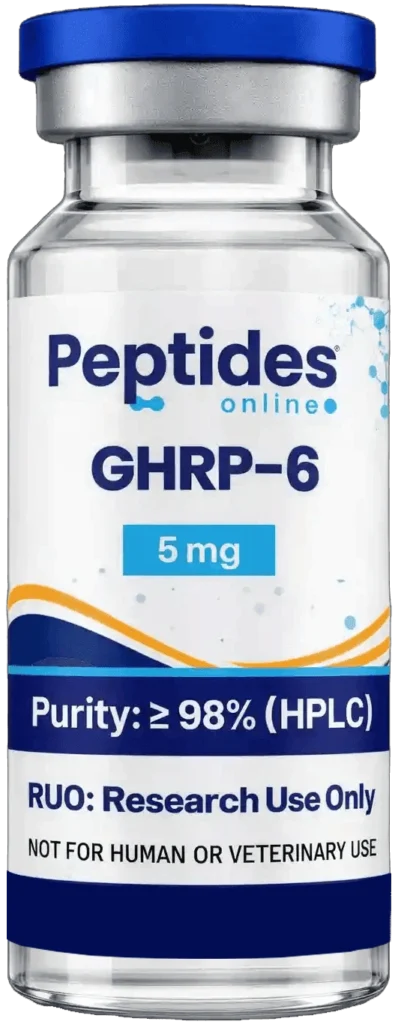
GHRP-6
GHRP-6 (growth hormone-releasing peptide-6) is a man-made hexapeptide which activates the growth hormone secretagogue receptor, alternatively named the ghrelin receptor. Ever since its discovery, GHRP-6 has become an essential compound used in experiments in relation to growth hormone secretion, endocrine control, metabolic signalling, appetite physiology, and neuroendocrine function in the laboratory setting. In preclinical and […]
GHRP-6 (growth hormone-releasing peptide-6) is a man-made hexapeptide which activates the growth hormone secretagogue receptor, alternatively named the ghrelin receptor. Ever since its discovery, GHRP-6 has become an essential compound used in experiments in relation to growth hormone secretion, endocrine control, metabolic signalling, appetite physiology, and neuroendocrine function in the laboratory setting.
In preclinical and in vitro experimentation, GHRP-6 can be used to study pulsatile growth hormone secretion, IGF-1 signalling, pituitary physiology, protein synthesis, muscle metabolism, appetite control, gastrointestinal hormone signalling, and the mechanisms of healthy ageing. Studies have examined the effect that the activation of the ghrelin receptor has on endocrine and metabolic responses. Nevertheless, at the moment, there is only laboratory and animal data available and further research needs to be conducted to gain a more thorough understanding of its biological effects.
Unlike therapeutic drugs, the GHRP-6 provided by PeptidesX is solely designed for research purposes including analysis and studies. The product cannot be used on humans or animals. Each batch is delivered together with a Certificate of Analysis which provides analytical information on the identity and purity of the batch. It is important that researchers check the Certificate of Analysis prior to conducting their experiments.
All GHRP-6 products provided by PeptidesX are solely for research purposes and cannot be used on humans or animals.
Research Areas
- The growth hormone secretagogue receptor (GHS-R1a)
- The growth hormone secretion and pulsatility
- The IGF-1 signaling pathway
- The physiology of pituitary gland and endocrine regulation
- The ghrelin receptor and its role in appetite signaling
- The protein synthesis and skeletal muscle metabolism
- The metabolic regulation and energy homeostasis
- The healthy aging and neuroendocrine pathways
⚠ Research Use Only.
All products supplied by PeptidesX are intended strictly for in-vitro laboratory and scientific research. Not for human consumption, medical use, veterinary use, or therapeutic application. Researchers are responsible for compliance with all applicable regulations in their jurisdiction.
Identity & Purity
HPLC / MS-UPLC| Test | Specification | Result |
| Appearance | White lyophilised powder | ✓ Conforms |
| HPLC Purity | ≥ 98.0% | 98.% ✓ |
| MS Molecular Weight | Expected ± 0.5 Da | Confirmed ✓ |
| Amino Acid Analysis | Theoretical sequence | Confirmed ✓ |
| Water Content (KF) | ≤ 8.0% | 5.4% ✓ |
| Net Peptide Content | ≥ 85.0% | 90.8% ✓ |
Safety Testing
Endotoxin / Metals| Test | Specification | Result |
| Endotoxin (LAL) | ≤ 5 EU/mg | 0.9 EU/mg ✓ |
| Bioburden | ≤ 100 CFU/g | <10 CFU/g ✓ |
| Lead (Pb) | ≤ 10 ppm | <0.1 ppm ✓ |
| Arsenic (As) | ≤ 5 ppm | <0.1 ppm ✓ |
| Mercury (Hg) | ≤ 3 ppm | <0.1 ppm ✓ |
| Cadmium (Cd) | ≤ 5 ppm | <0.1 ppm ✓ |
Solubility: Water / Acetic acid. Mix gently by rolling — do not vortex.
Returns: Sealed, unopened vials may be returned within 14 days of receipt. Opened vials cannot be returned.
GHRP-6 is a synthetic growth hormone releasing peptide that stimulates the growth hormone secretagogue receptor (GHS-R1a). This chemical is commonly used in experimental studies on endocrinology, hormone secretion, and metabolic signaling.
This chemical is used in research because it stimulates the growth hormone secretagogue receptor (GHS-R1a), which makes possible the studying of growth hormone release, ghrelin signaling, pituitary function, and endocrine regulation.
Yes, it can be obtained for laboratory research from PeptidesX in the United Kingdom. This chemical is available exclusively for scientific investigation and not for any human and veterinary uses.
Choose the desired GHRP-6 product on the PeptidesX website and place an order through the site's checkout page. All the products offered on the site have research-use-only status.
All the batches are independently tested and provided with batch-specific documentation. The Certificate of Analysis should be reviewed to confirm its identity and purity.
Research is carried out to find out more about growth hormone secretion, ghrelin receptor activation, appetite regulation, IGF-1 signaling, endocrinology, and metabolism.
Most research involves pituitary hormone regulation, growth hormone pulsatility, signaling of appetite, skeletal muscle biology, metabolism, hormonal responses, and aging in laboratory animals.
GHRP-6 is offered as a lyophilized research peptide for use in laboratory research purposes. Specifications for the product, purity details, and batch certificate are all available on the related product page.
The researcher should store the product according to the guidelines provided on the product label and Certificate of Analysis. The researcher should protect the product from extreme heat, moisture, light, and temperature variations.
Preclinical studies have indicated stimulation of growth hormone release in response to the stimulation of the growth hormone secretagogue receptor. Nevertheless, these findings are generated through laboratory experiments and cannot be taken as proof of safety or efficacy in humans.
Yes. Researchers study GHRP-6 in research experiments that involve endocrine physiology, signaling of ghrelin receptors, IGF-1 regulation, metabolism, appetite regulation, and aging studies
No. GHRP-6 is an investigational research peptide and does not get marketed as a medicine, dietary supplement, or treatment by PeptidesX for any disease.
No. PeptidesX sells GHRP-6 strictly for research purposes only. Results obtained in cell cultures and in animals cannot be used to claim safety, efficacy, or suitability for humans.
Delivery methods inside the UK can be chosen at the time of purchase. All shipping methods, delivery times, and prices are available on the website prior to making the purchase.
GHRP-6 is offered to universities, research laboratories, biotech firms, science institutions, and researchers conducting genuine scientific research.